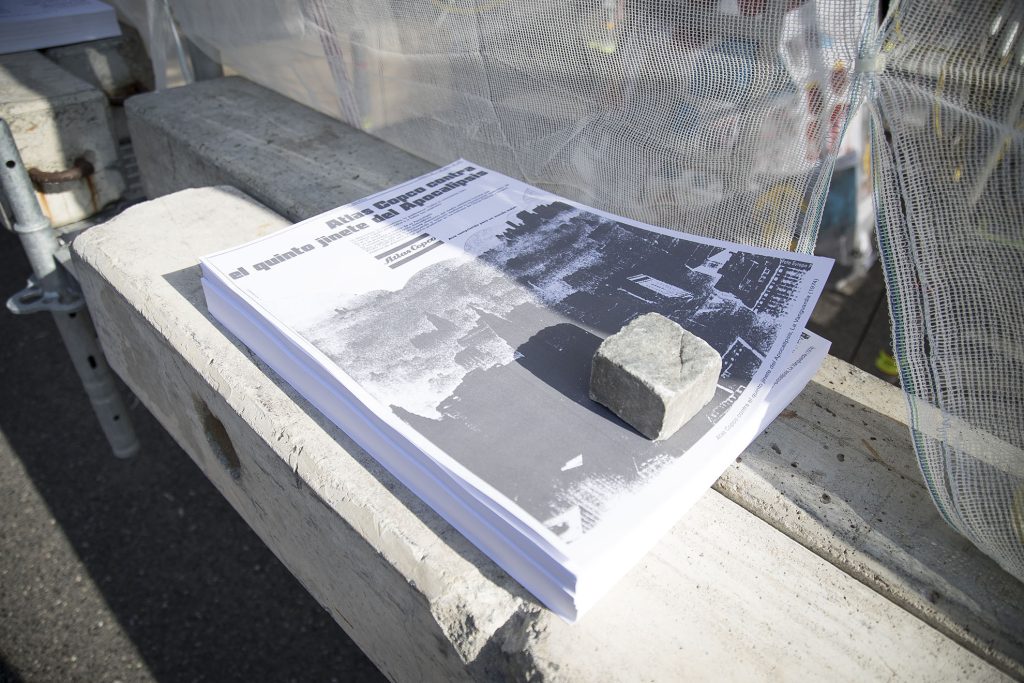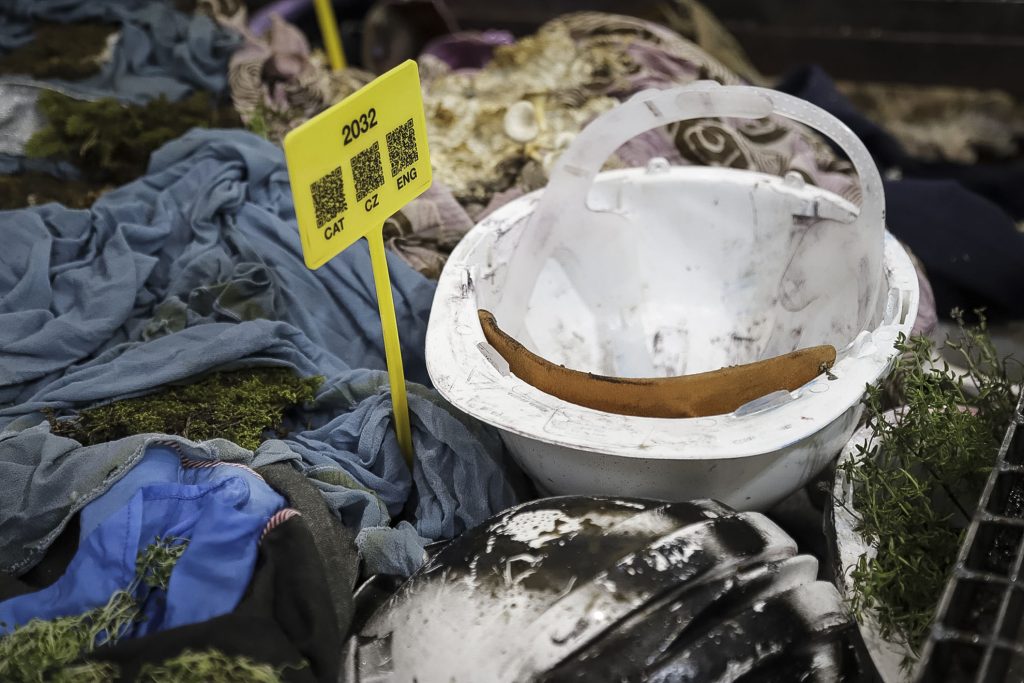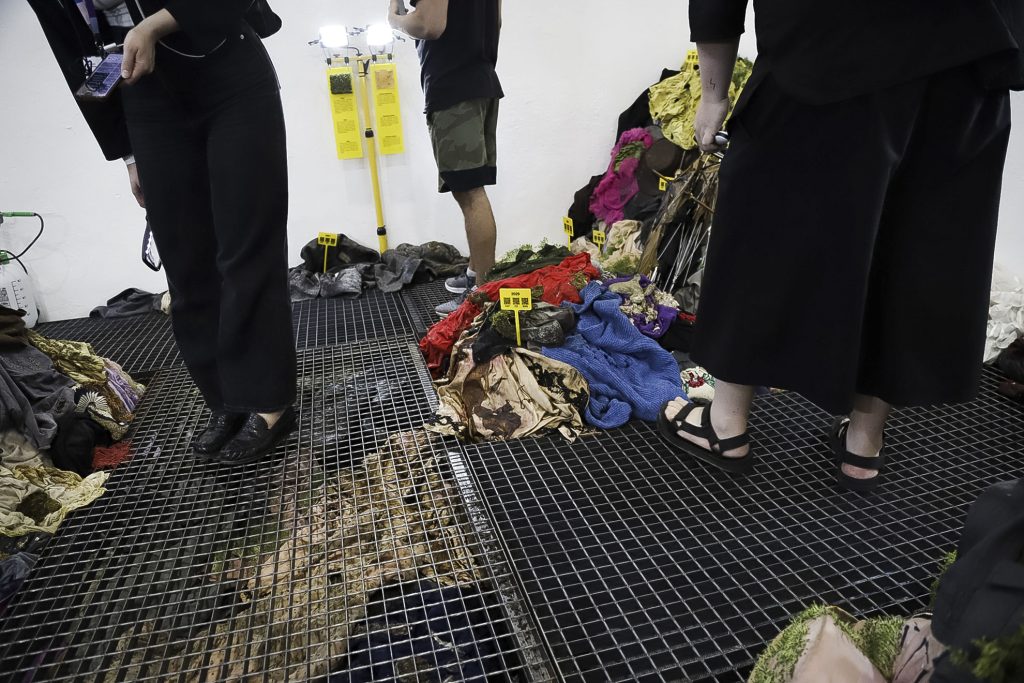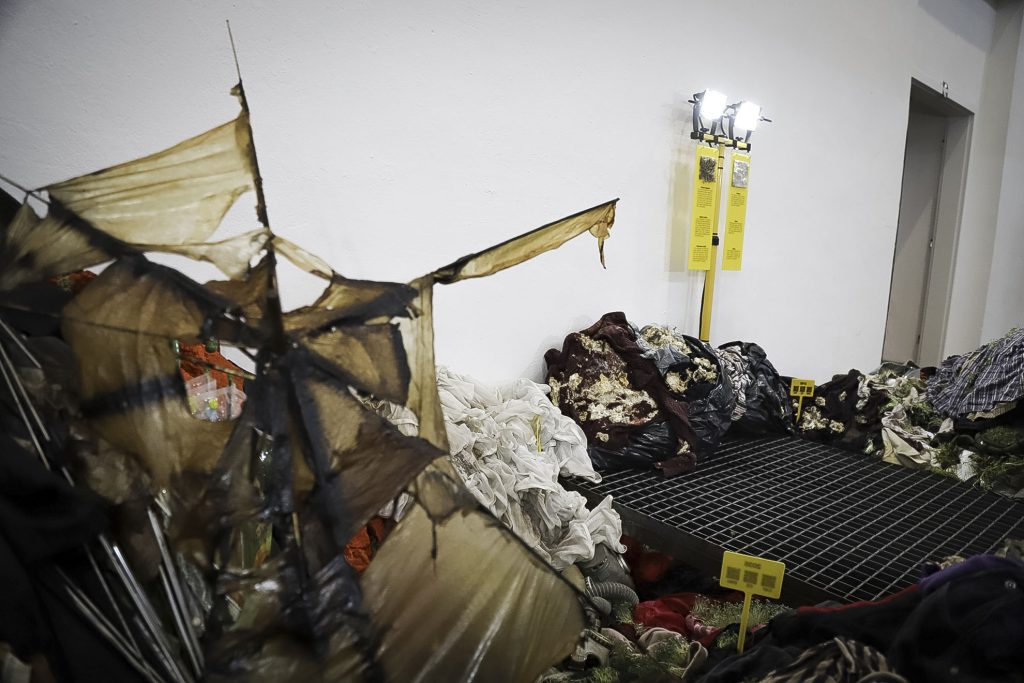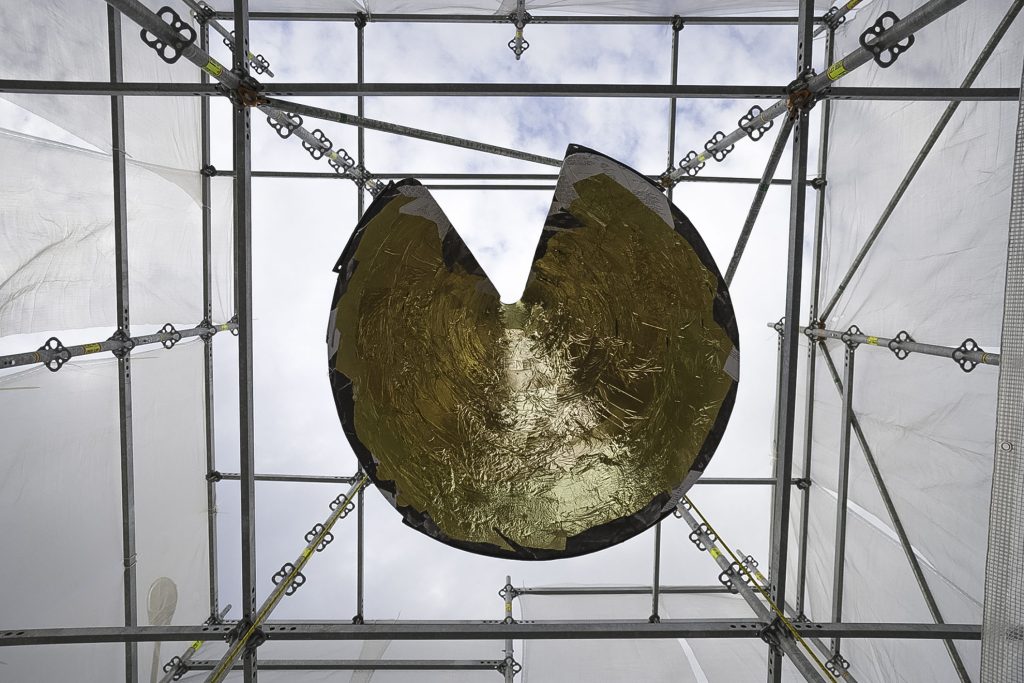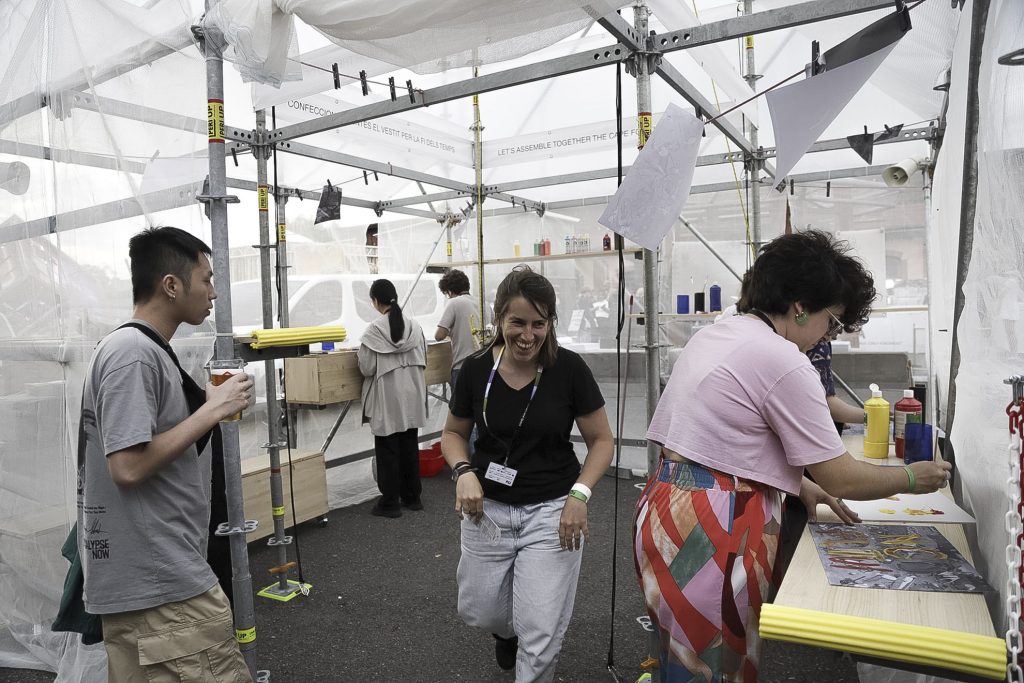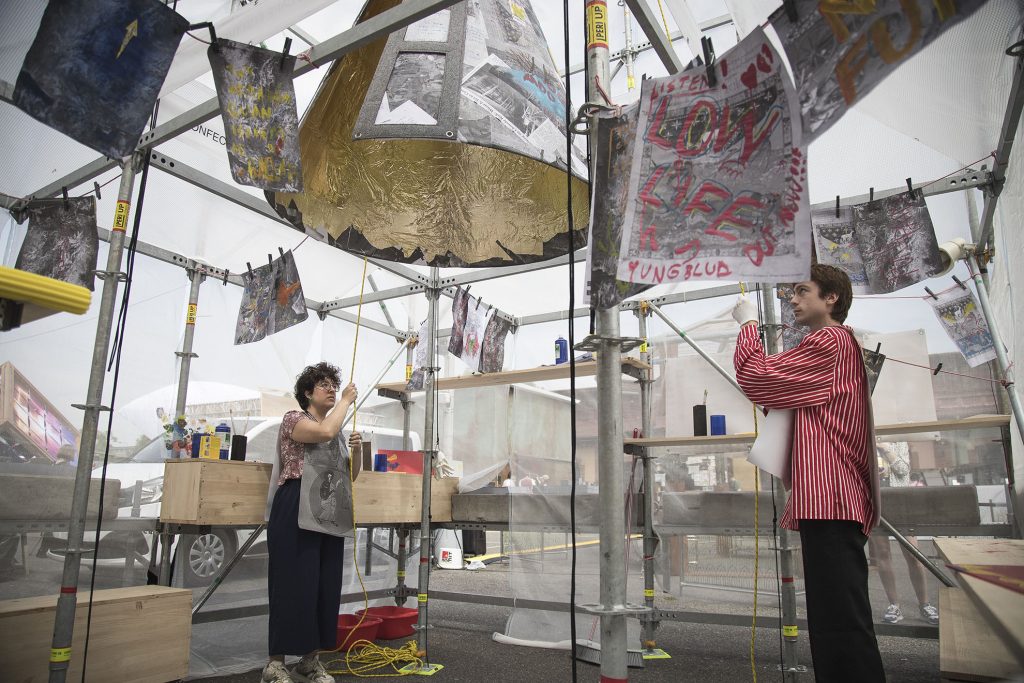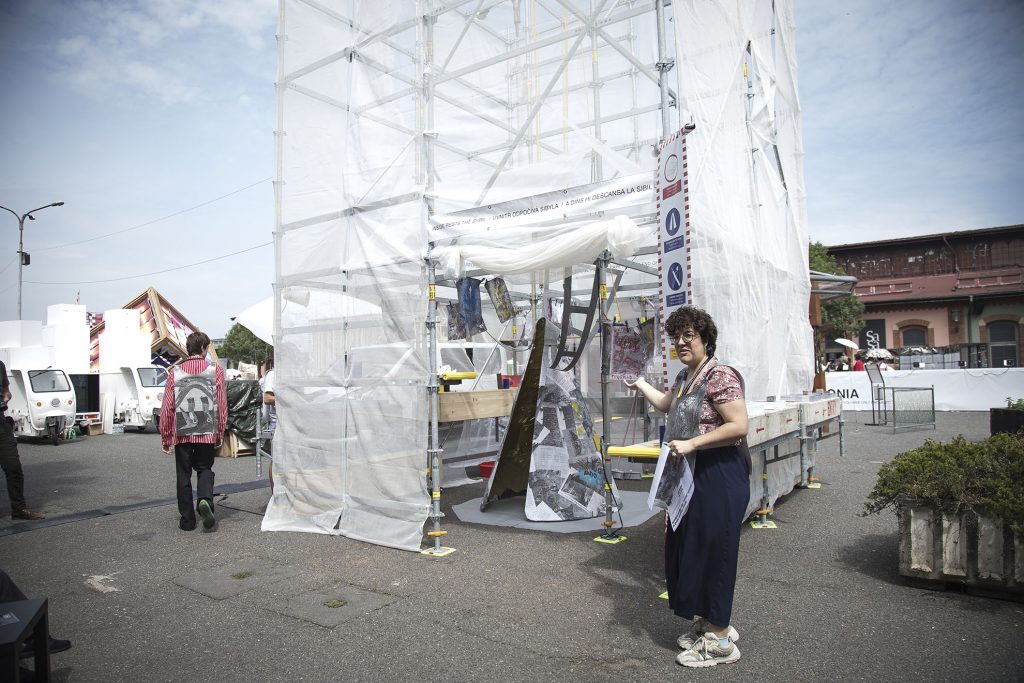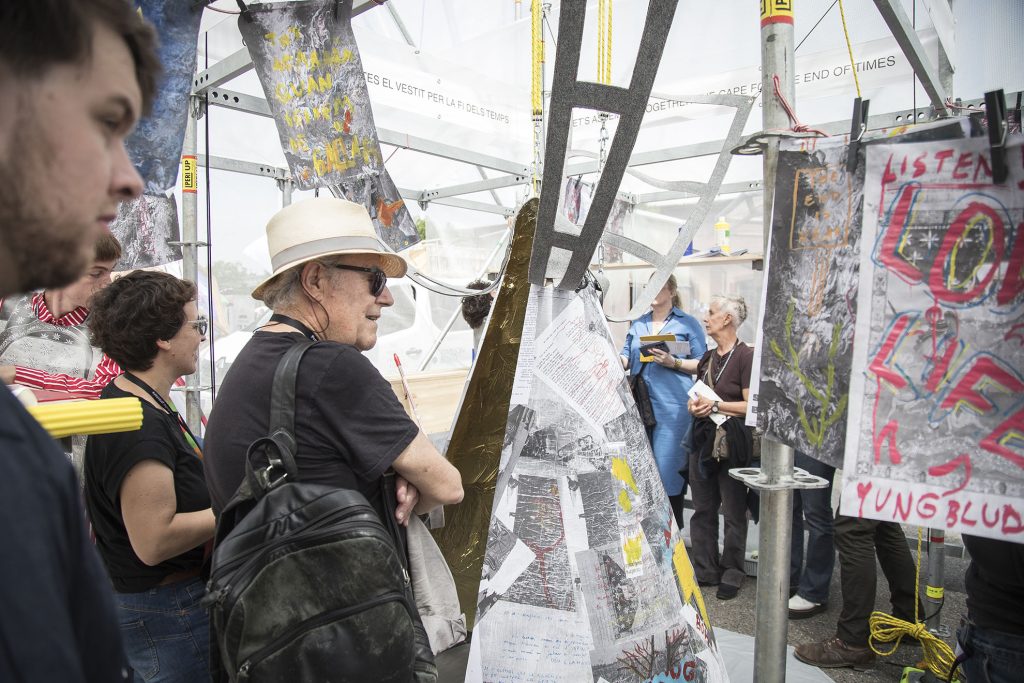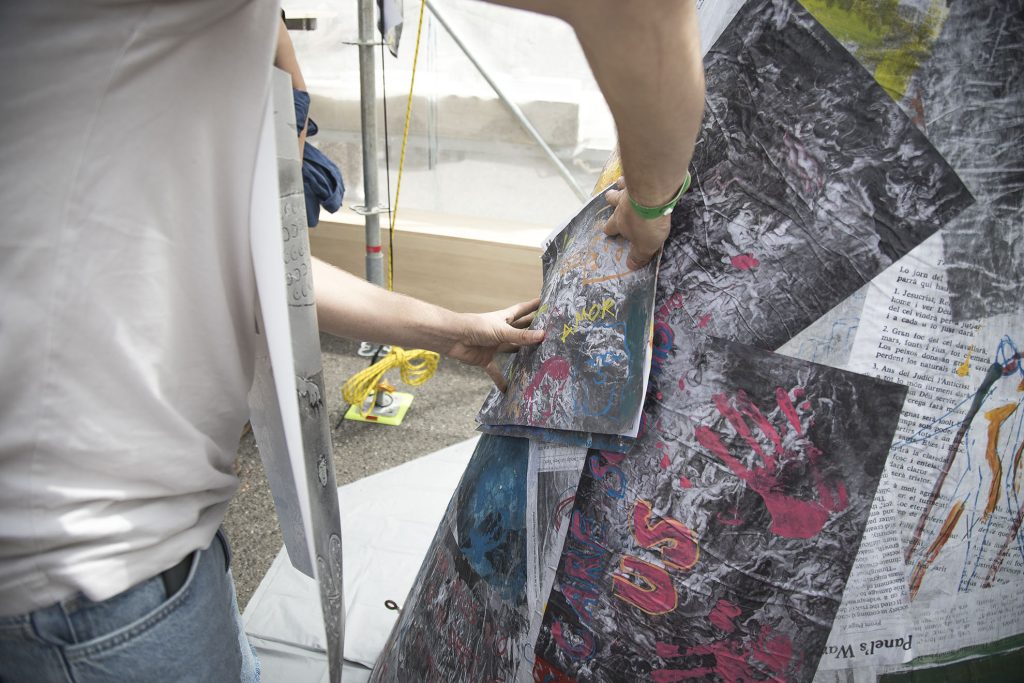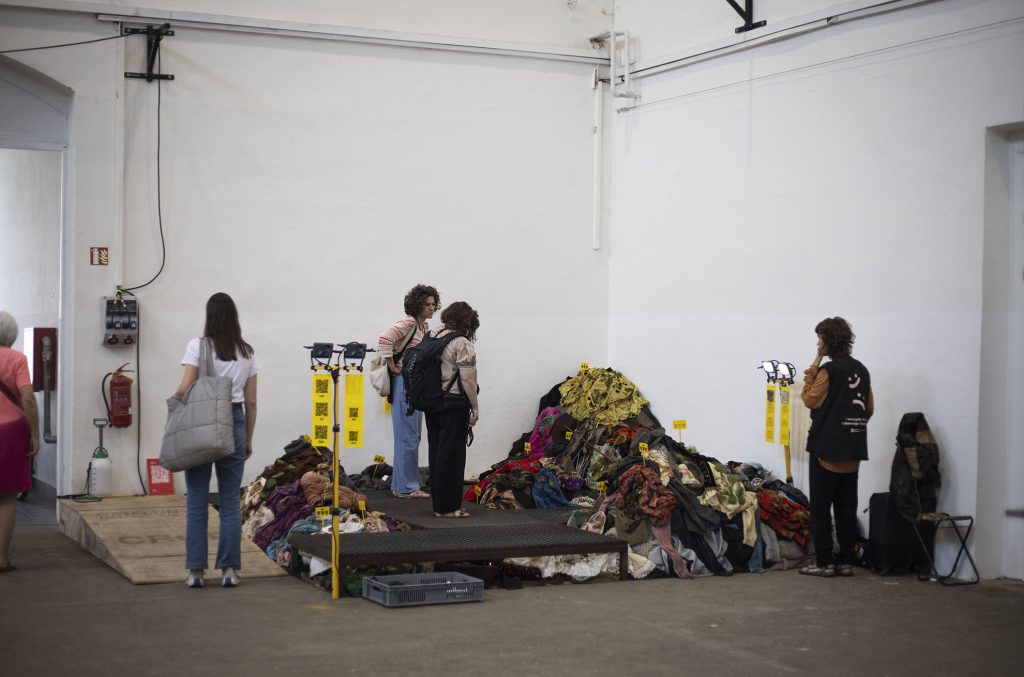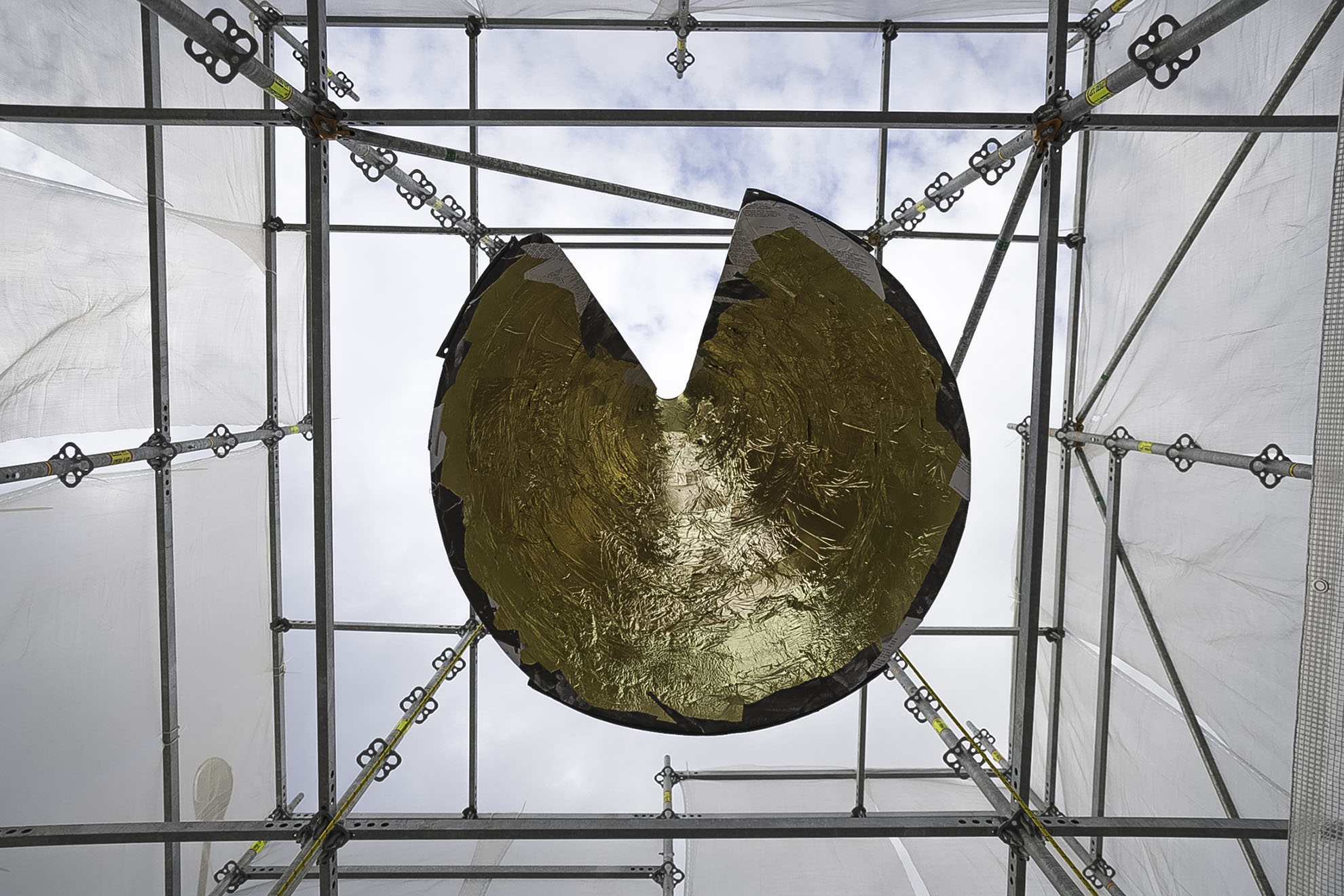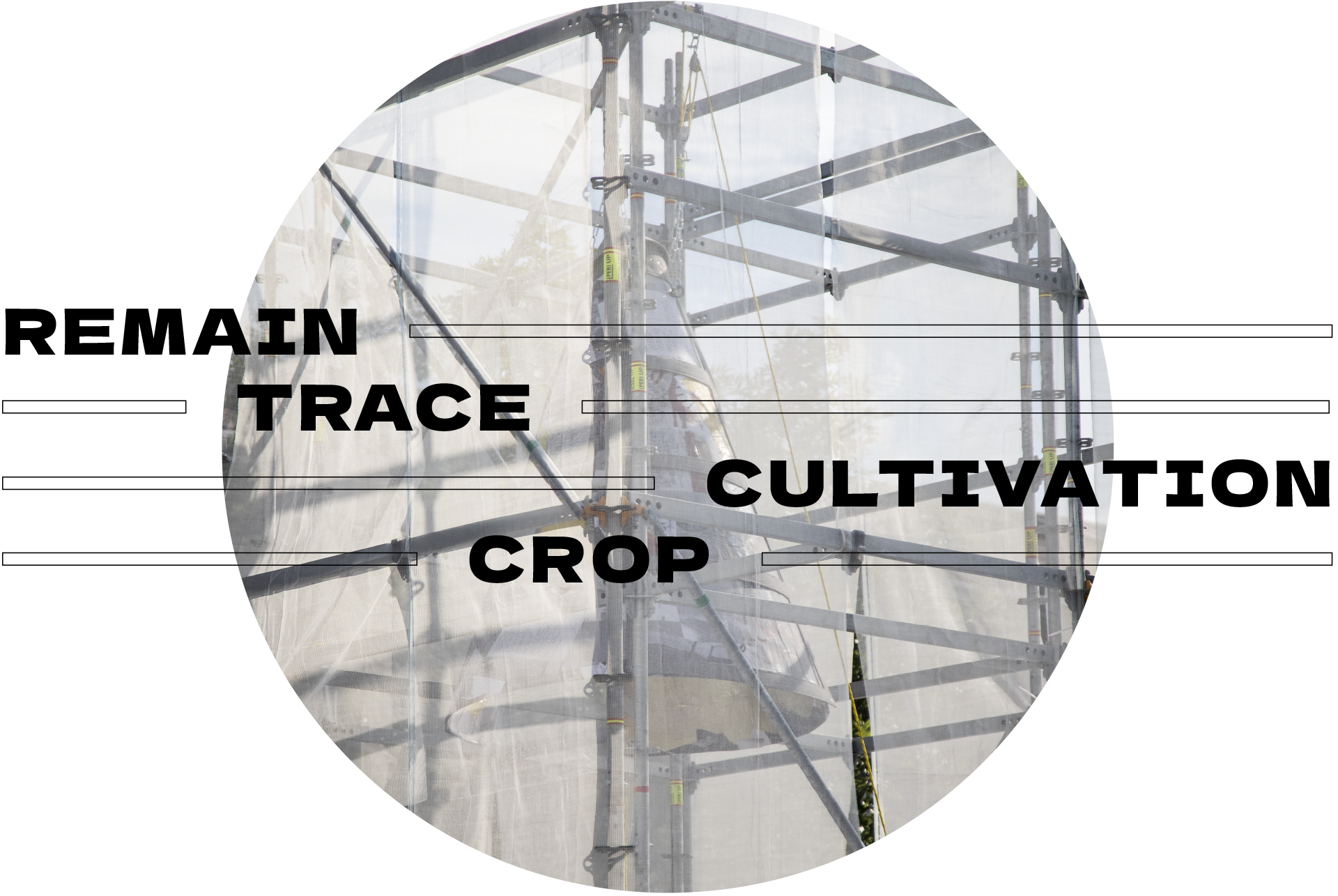
In On the Concept of History (1940), the German philosopher Walter Benjamin wrote: “There is no document of civilization which is not at the same time a document of barbarism”, and it seems that CROP and The Chant of the Sibyl rest on this idea that lies at the heart of a still burning issue. Both installations approach culture as an intangible fact which, when becoming communal – performance, fiction, vision, ritual –, has been embodied and palpable. We see cultivation as what is grown1 over time – millennia or decades – as a representation of a community of either beneficial or perverse,2 aspiration, although almost never innocent. Culture appears as a remain or trace of what has existed; a document whose plot is made of citations, with the nuance that it renders it shifting and alive.3 The living organisms are born, grow, reproduce and die. They turn mouldy,4 later. Like a landscape.5 Like a hypertext.
Sebastià Portell
1
CROPS, GROWING, CULTURE
Cultivation: the act of preparing land and growing crops on it, or the act of growing a particular crop. Cambridge English Dictionari
We are cultivated people. We have millions of bacteria. Estíbaliz Espinosa
There is a hand, and in the hand, seeds
And there is the land ready to be cultivated:
The location is right, it has sufficient hours of sunshine −
And it has already been fertilised
− You can smell the dung on the other side
Where you and I are now, both far enough away not to get dirty
And close enough to follow it
And be able to say the key is in the hoe, the movement,
It is important to wait, you need to follow the process,
Statements that do sound good.
There is a hand, I said, and in the hand, seeds
Which will have to be planted carefully
Within the space delimited by the plots:
The beans with the beans separately
And the tomatoes here, as has been always done.
It is logical, you say. It is poor, I reply.
It is poor and I would even say scary
To follow an order imposed, so much purity
And so little to question these straight lines,
Patterns of regular, symmetrical rows
Like graves buried without a slab
From which nothing can any longer grow or die
And of course the fact that nothing can grow is a problem,
But that it cannot die is a catastrophe.
There is a hand, still this hand
That holds the seeds for the crop
And knows the exact size of the land
As your father, and your father’s father, knew.
It is tradition and excellence, you argue,
And I see you admiring the body that precedes the hand
And it surprises and hurts and deceives, you don’t know how much,
That you don’t see the absence, that you don’t care
And don’t wonder where your mother has been til now
And where your daughter will be other than at home.
The tradition you advocate has the colour
Of the knife with which she, nameless like all,
Is just about to cut the neck
Of an animal that will end up on the table,
Chopped up, with vegetables, the vegetables
That the field has given us, thanks be to God
Bless this table and we swear
To say nothing of the violences
And so we’ll be accomplices just as much as You, Amen.
There is the hand, I repeat, and the question:
Why is a single hand responsible for sowing
If the makers of the kitchen garden are so diverse?
On this piece of land, for example,
You should keep in mind the worms, nearly one thousand worms
That every day and in the dark, what an offering,
Manage to speed up the composting
Process, and do so without a word,
Without expecting front pages or applause
Although they know the end of this story,
They know that everything will be for the owner of the hand,
The hand that has appeared in the first verse,
The hand that will approve the brand, the recognition
“Thank you all for being here today, it is an honour,
I’m happy the critics appreciate
The effort I’ve made so far. My radishes,
My carrots, my peppers are for you.”
Until when this worship of the I,
Until when the indifference for what adds,
For everything that is there and can be seen only if you so desire?
There is the hand, the hand that holds the seeds
And at this point we believe we know them.
Precisely of high points comes to speak
The bird flying over the landscape now
(We’ll notice it because for some time
Its shadow has been cast on the wrist
Of this hand which, certainly, overwhelms us).
You need to look up, to fly very high and project yourself
You have proclaimed with the tone of a visionary,
Of someone who sees the fruits that will go
To a supermarket let’s say in Greenland.
For you reaching far means working
So that the seeds grow products
That can be understood everywhere, that are not too acidic.
This for me instead means exports,
Ten thousand planes crossing the sky, pallets and boxes,
Three tons a month of tasteless fruit,
Which being so digestive can cause anxiety.
But go ahead, look very high and slowly forget
What you have nearby, what takes roots in the soil,
How much water it needs, if it has been thirsty for long.
Then, however, don’t do like so many others,
Don’t blame the land for not being fertile
Don’t say how can it be, what a tragedy.
I know: being consistent is very hard
You feel very settled in the distance
That words impose with facts
(So says someone who speaks to you in a poem
And who turns the metaphor into a curse,
And wants the curse to have effects,
To call attention, like the dawn on the sunflowers.
So says someone who is haltingly writing the last verses
Just when the hand that guides the text disappears
And does not bid farewell to it because it suddenly begins to rain,
It’s raining a lot, it rains so much that he will have to go home
And you’ll remain between the crop and the metaphor,
There where you won’t be able to see how many puddles
There are right now on the asphalt).
Calafell, Mireia. Nosaltres qui.
Barcelona: LaBreu Edicions, 2020.
2
My time is not yours. Neither is it mine. Time
Depends on the speed of the clock that measures it,
And the speed in me is not the speed in you,
For such a sharp reason as it is
That the journey you make is not the journey I carry with me.
I want to say that you shouldn’t apply a dissembling copyright on time,
While scholarly speaking of “our time”,
Because those who love just their time
And certain traditional images of man
Have more or less communed with Germany.
My task is to See what there is, not what’s going on…
What’s going on sees me.
I want to see just the man, to see if he is alive,
Above all the human splendour in which the crisis is the personality.
Instead, however, seeing the man who lives in crisis,
I am fed up of seeing little men who live from the crisis,
And this is because
Those who love only their time
And certain traditional images of man
Have more or less communed with Germany.
If you want to be a man,
Try, first at all, to be vigilant.
Try not to have a master
Who trains you in the image of his clinical picture.
He will just show you that you maintain it
And you commune with his cave painting,
If what you want is to be given the card of subject.
That way you will catch the filthy disease of decency
And the coarse dirt of silence. You will be an aesthete
And this is the jug of beer
That helps you swallow the mouldy bread,
But those who love just their time
And certain traditional images of man
Have more or less communed with Germany.
If you want to be a man,
You don’t have permission to think that you were born as such.
You were not born a man, but you have to return.
Your only task is to ensure
That clear things become public.
Woe to you, however, if you allow the others to make you man
You will catch the dirty disease of decency
And the rude roar of silence. You will be an aesthete,
And that's because
All those who love only their time
And certain traditional images of man
Have more or less communed with Germany,
And this is the jug of beer
That helps to swallow the mouldy bread.
If you want to be a man, don’t say that the foot of a man
Is more modern that the hoof of a horse.
Never say just “I” when you do a thing correctly.
Never dare say just “I” when you do a thing wrongly
Never try to say “flower” to a faded flower.
Never dare say “fight” to a carnage.
Do not approach the pig that says “undocumented”
To someone who does not carry their parents, street and gender written on a piece of cardboard.
You are shameless, if you think
That everything that a card says about a person is true.
If you comply with all this, you will be an aesthete,
And this is a jug of beer
That helps to swallow the mouldy bread.
I believe in justice and in the righteous
But, as the authority is mutual or is not,
In exchange for my faith in justice,
Don’t let any judge from here in Catalan or from the country dare
put his signature, or flourish, under pain of 12 bullets,
If he is not himself, from his own hand,
Who put the convict to the garrotte, the gallows or the bullet.
Because the gallows, the bullet and the signature must bear the same hand.
Otherwise, you are
Like those who love just their time
And certain traditional images of the man,
Because they have more or less communed with Germany,
And this is a jug of beer
That helps to swallow the mouldy bread.
Bonet, Blai. Has vist, algun cop, Jordi Bonet, Ca n’Amat a l’ombra?.
Barcelona: Borràs Edicions, 1976.
3
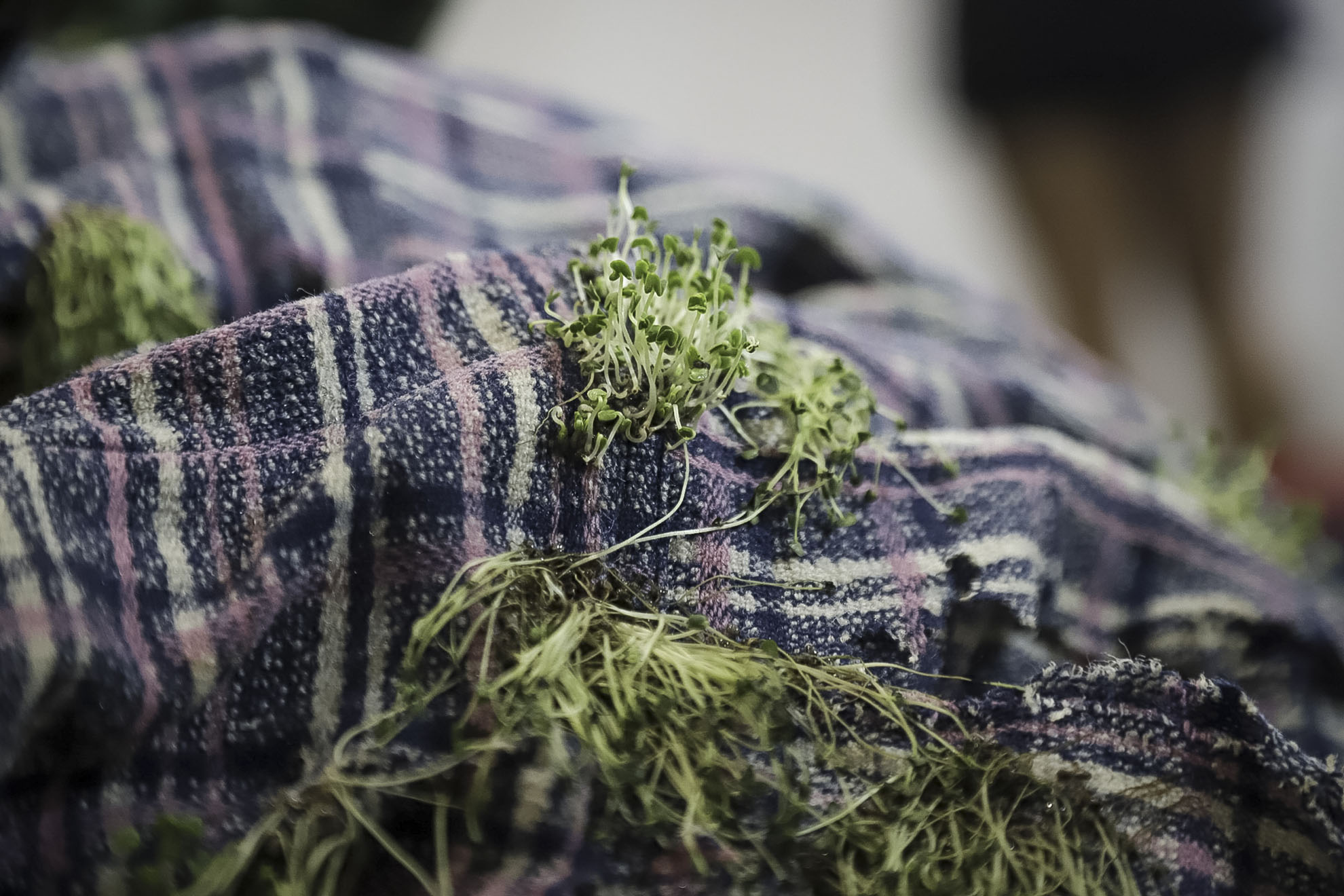
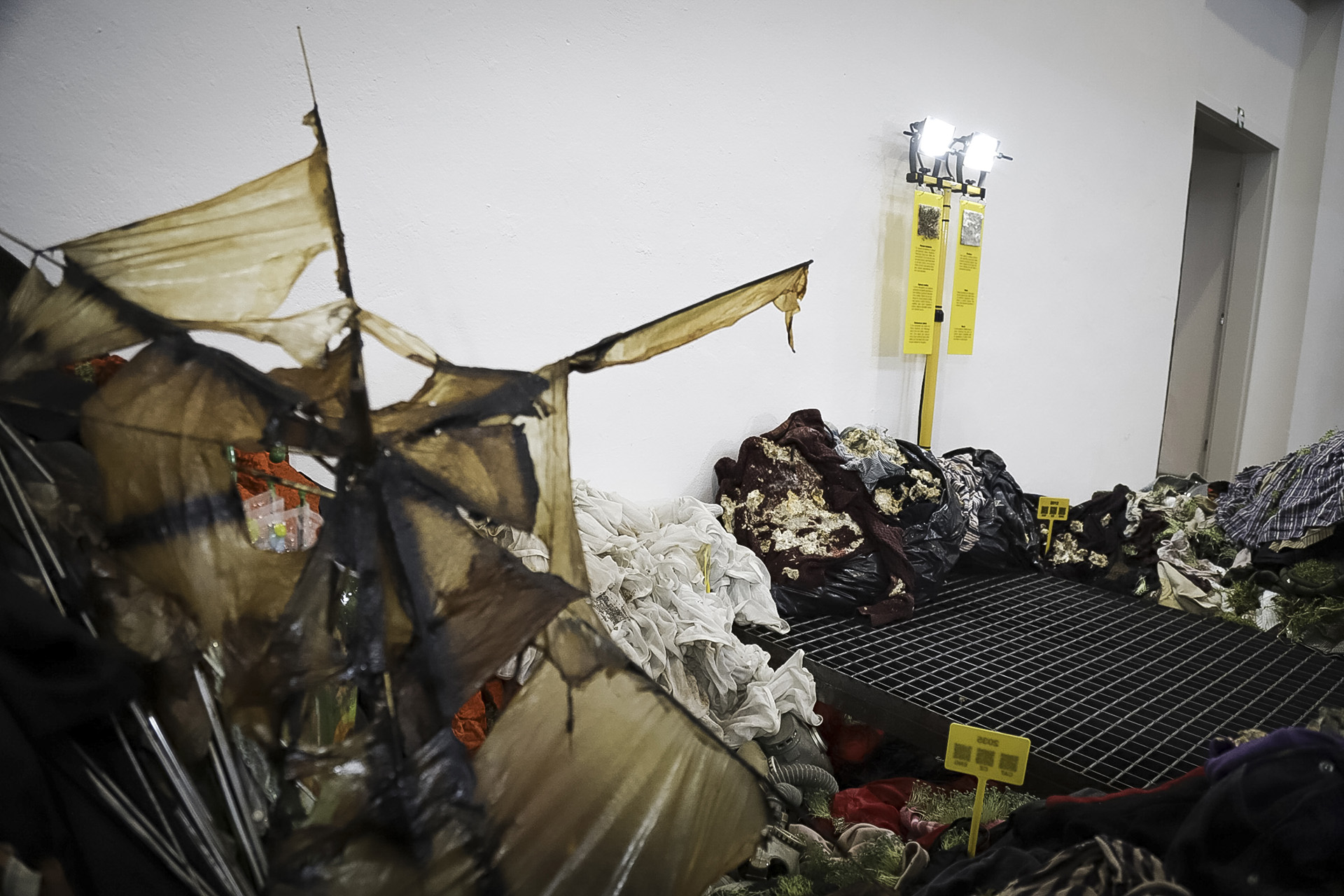
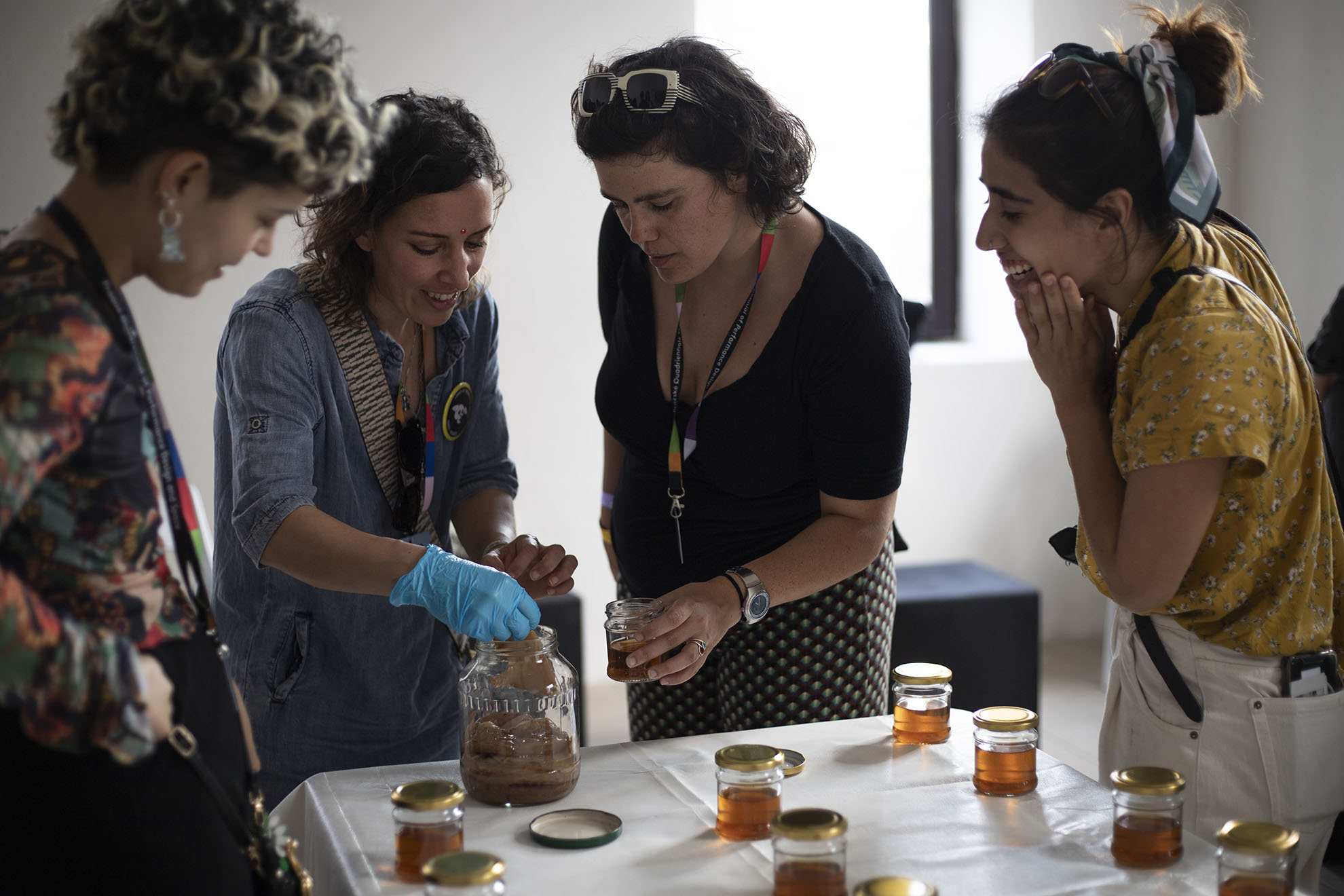
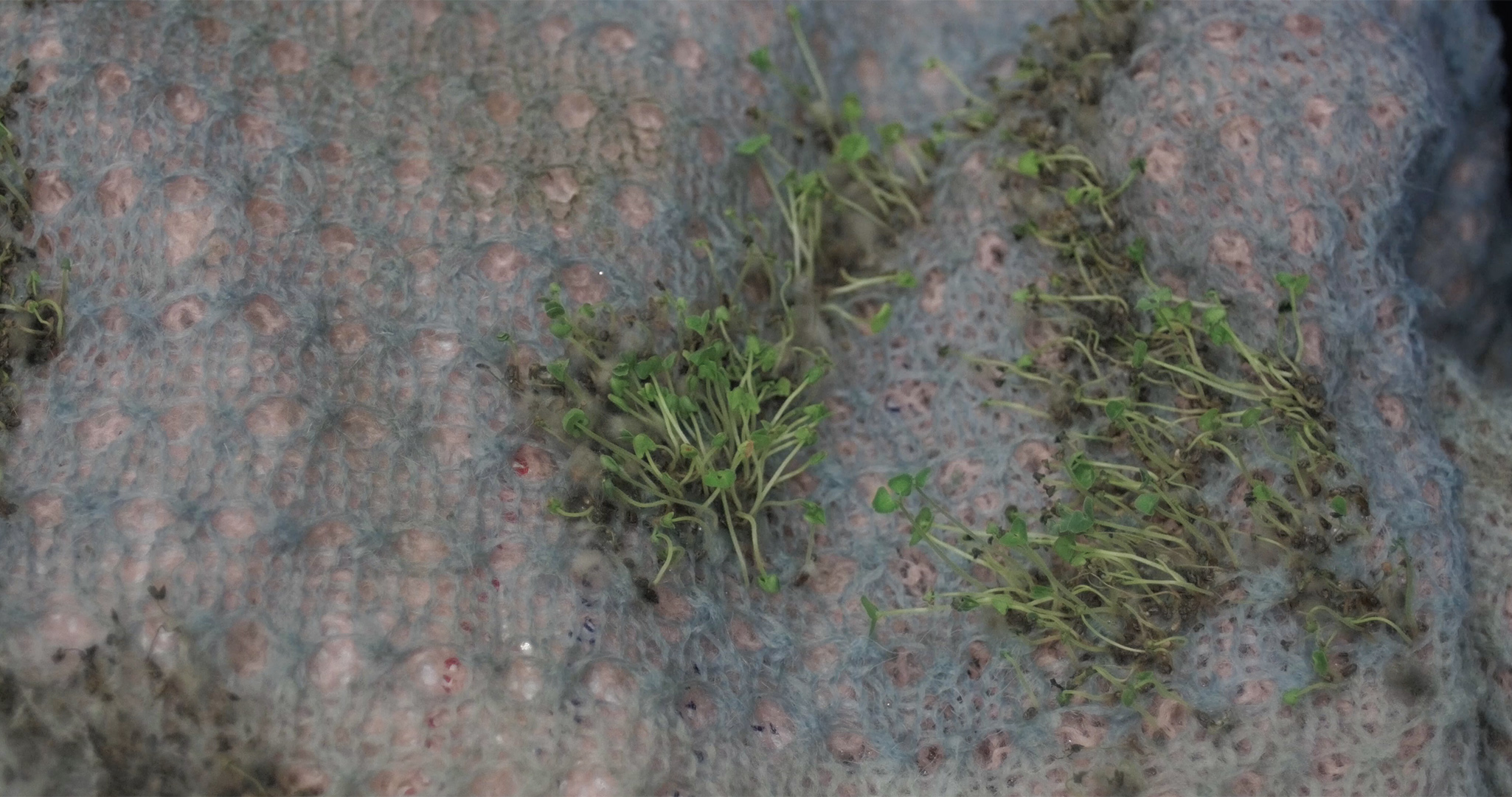
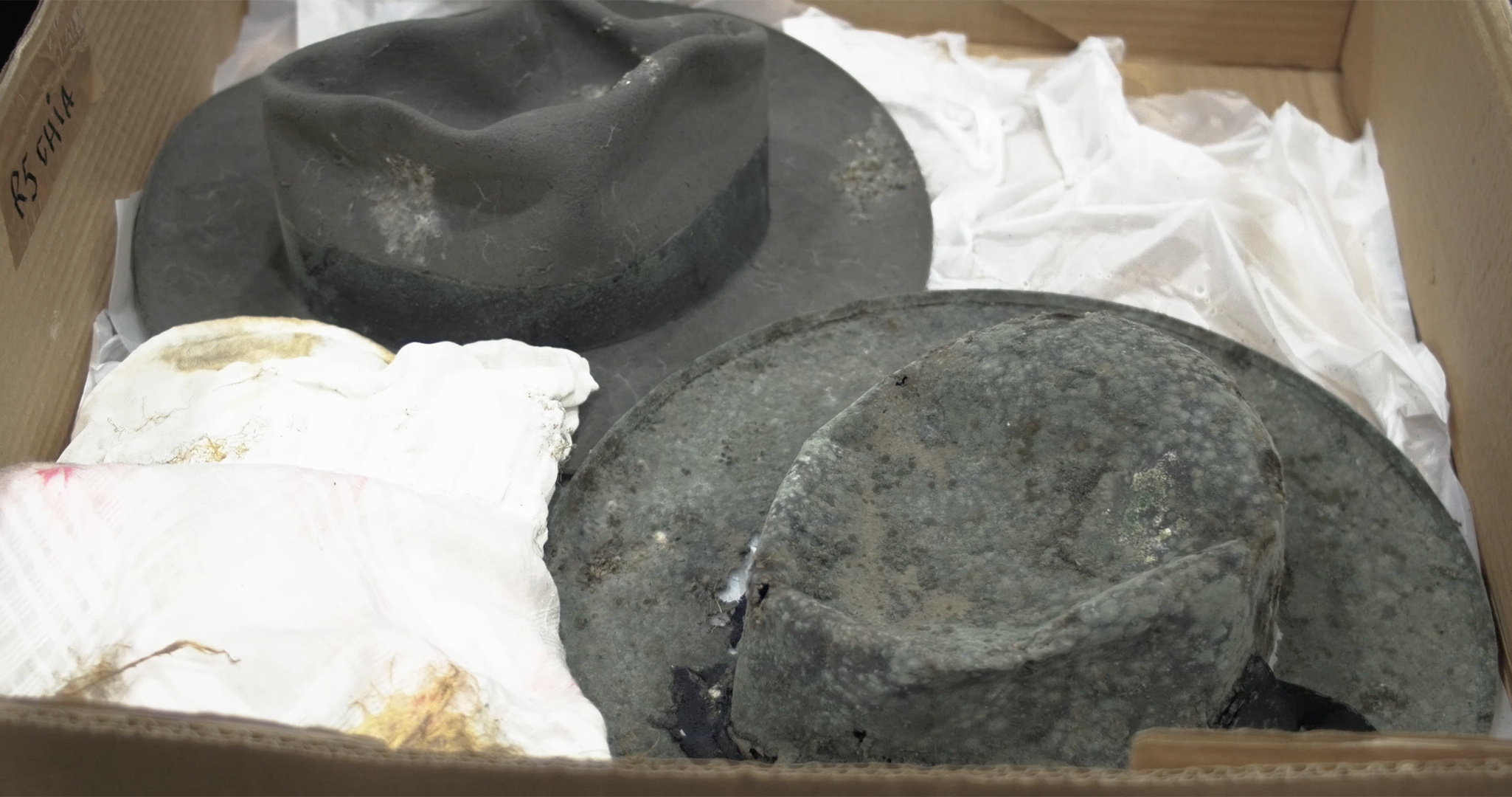
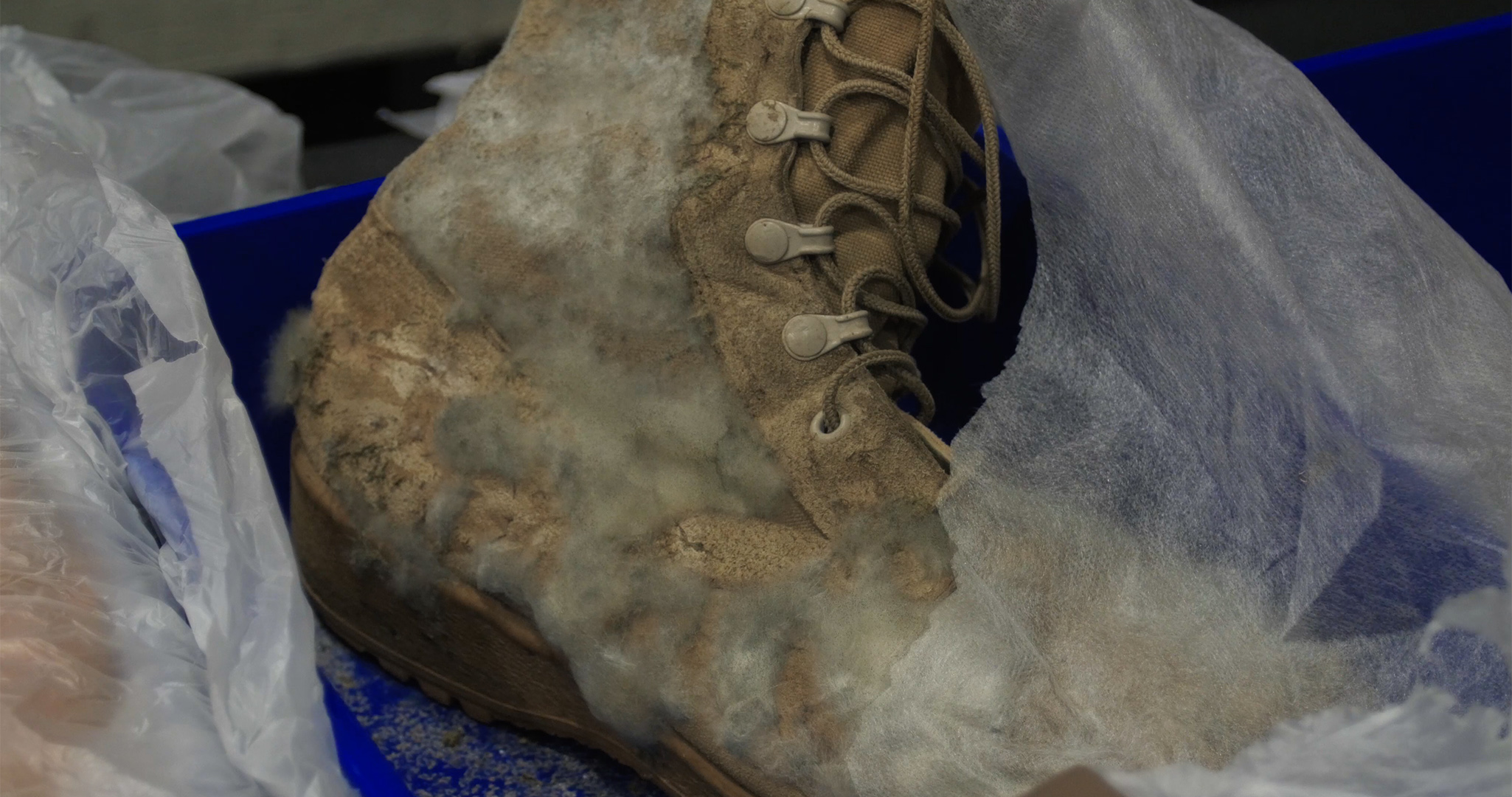
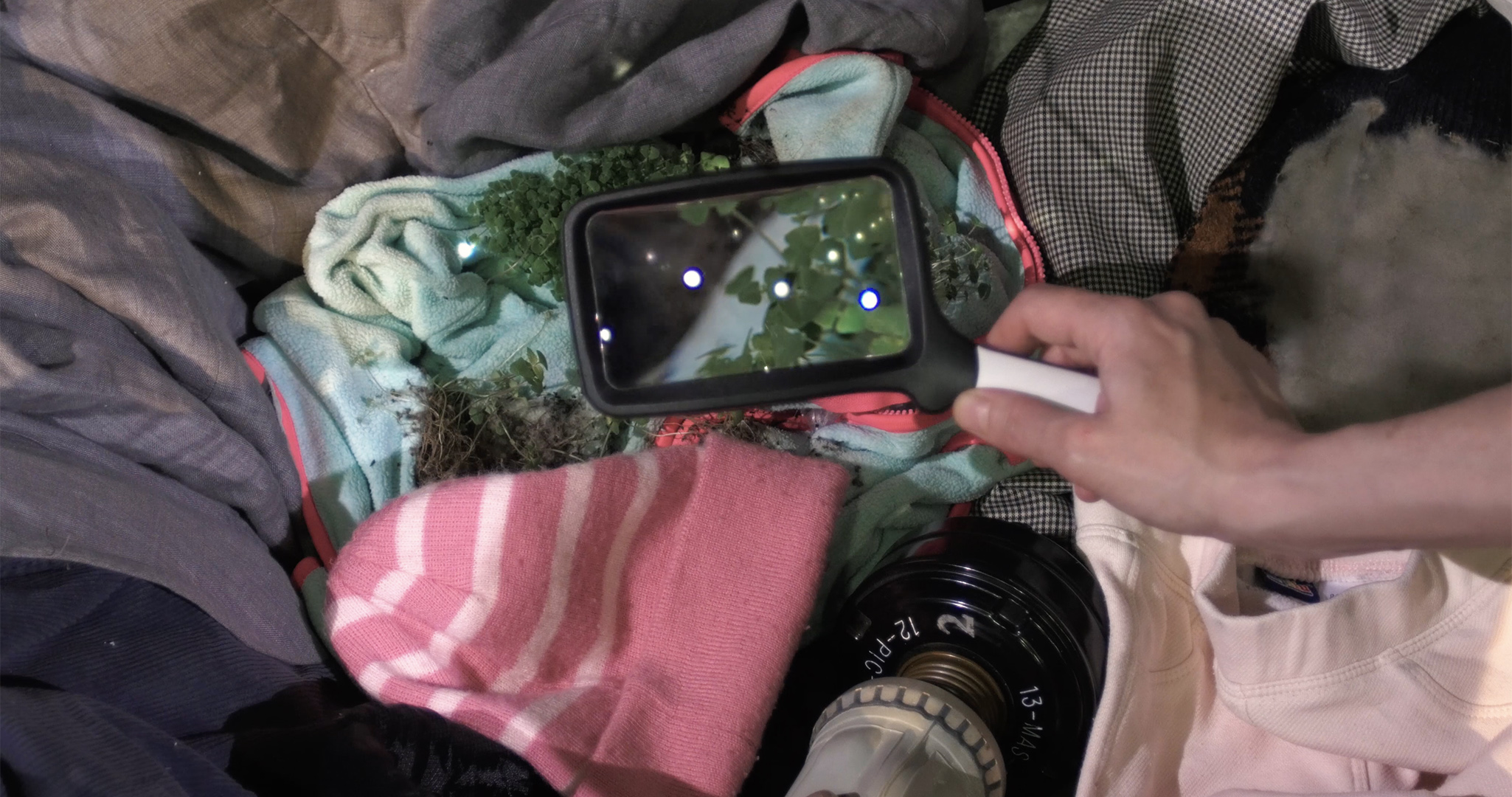
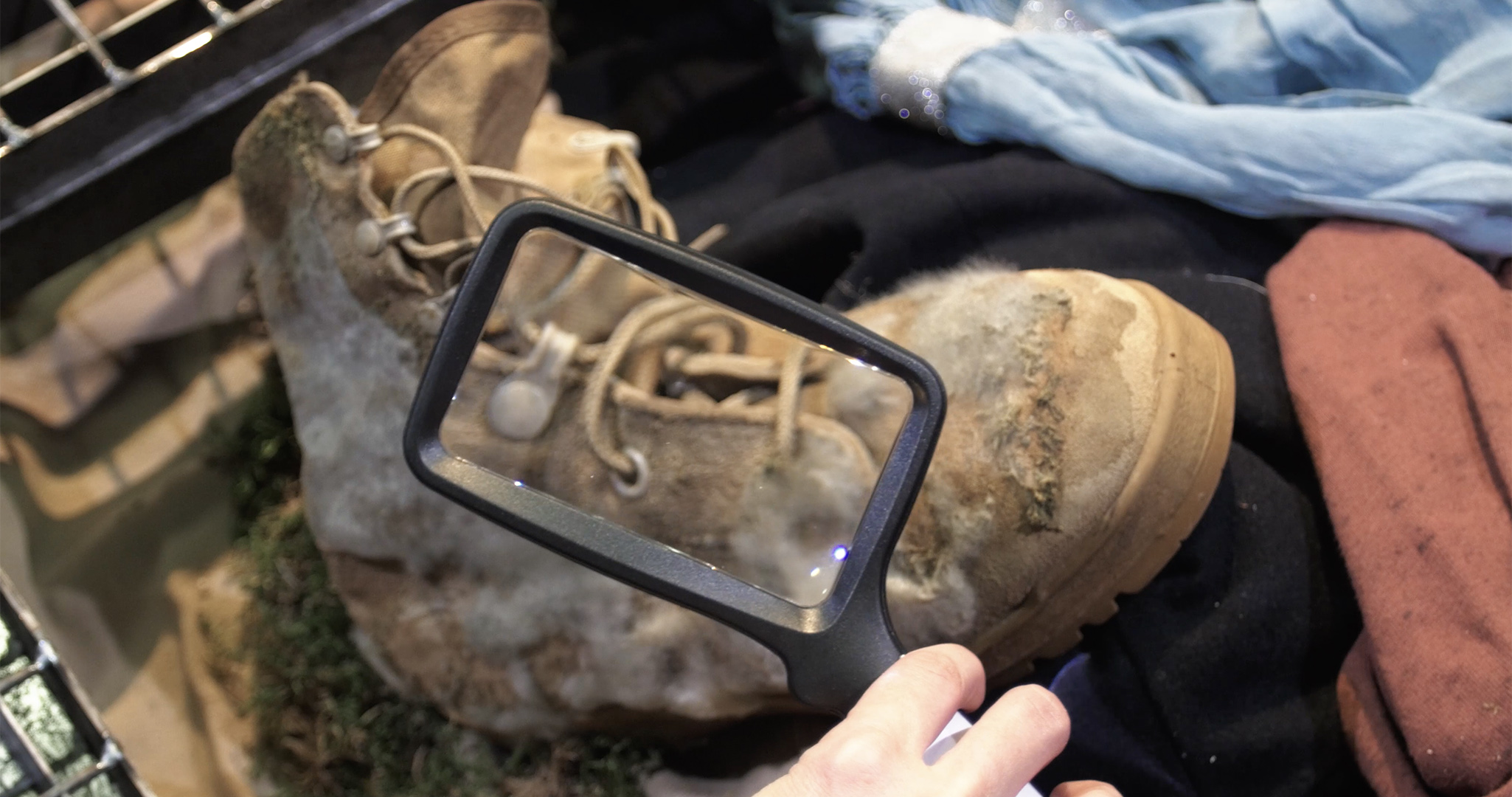
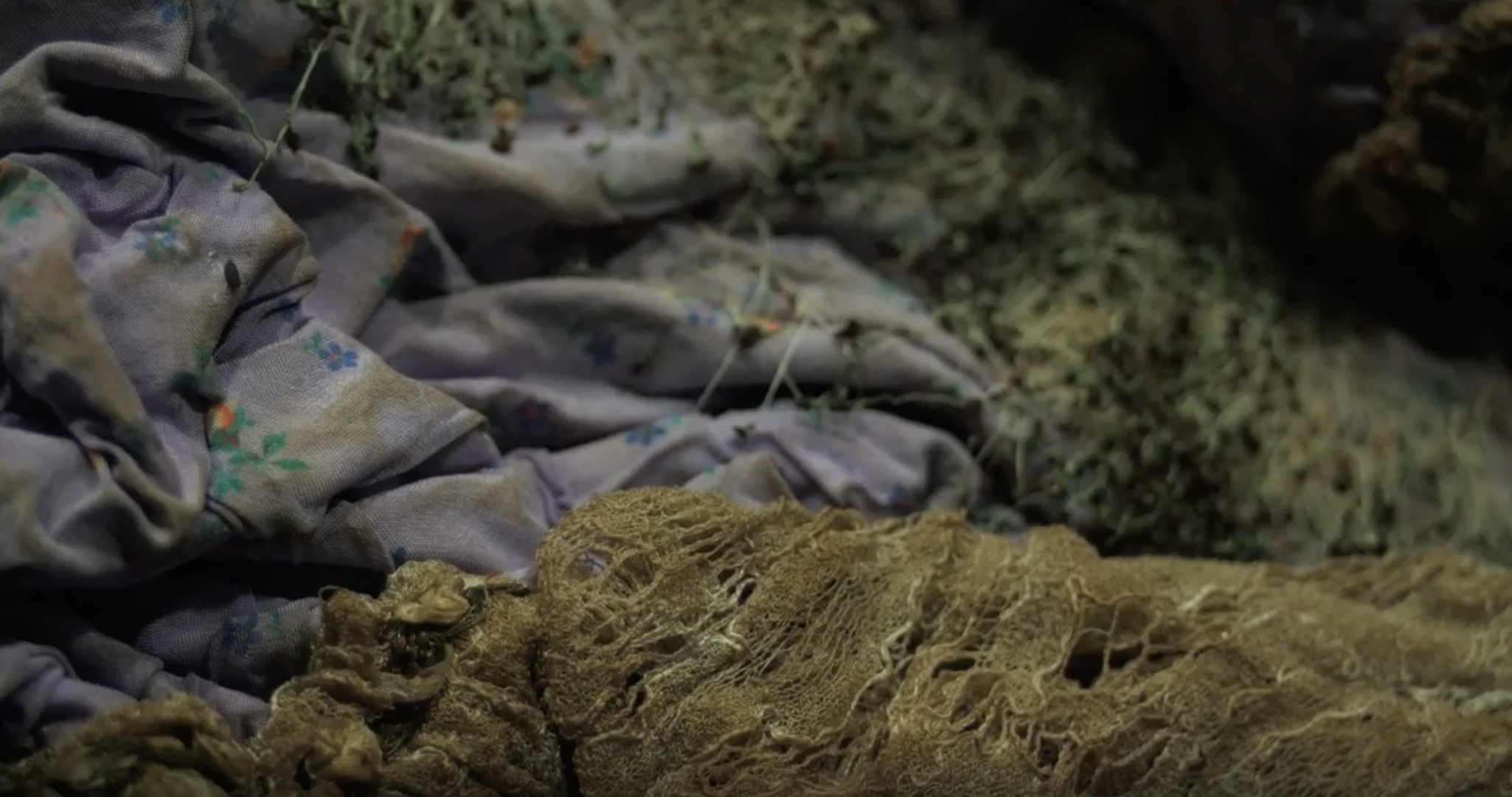
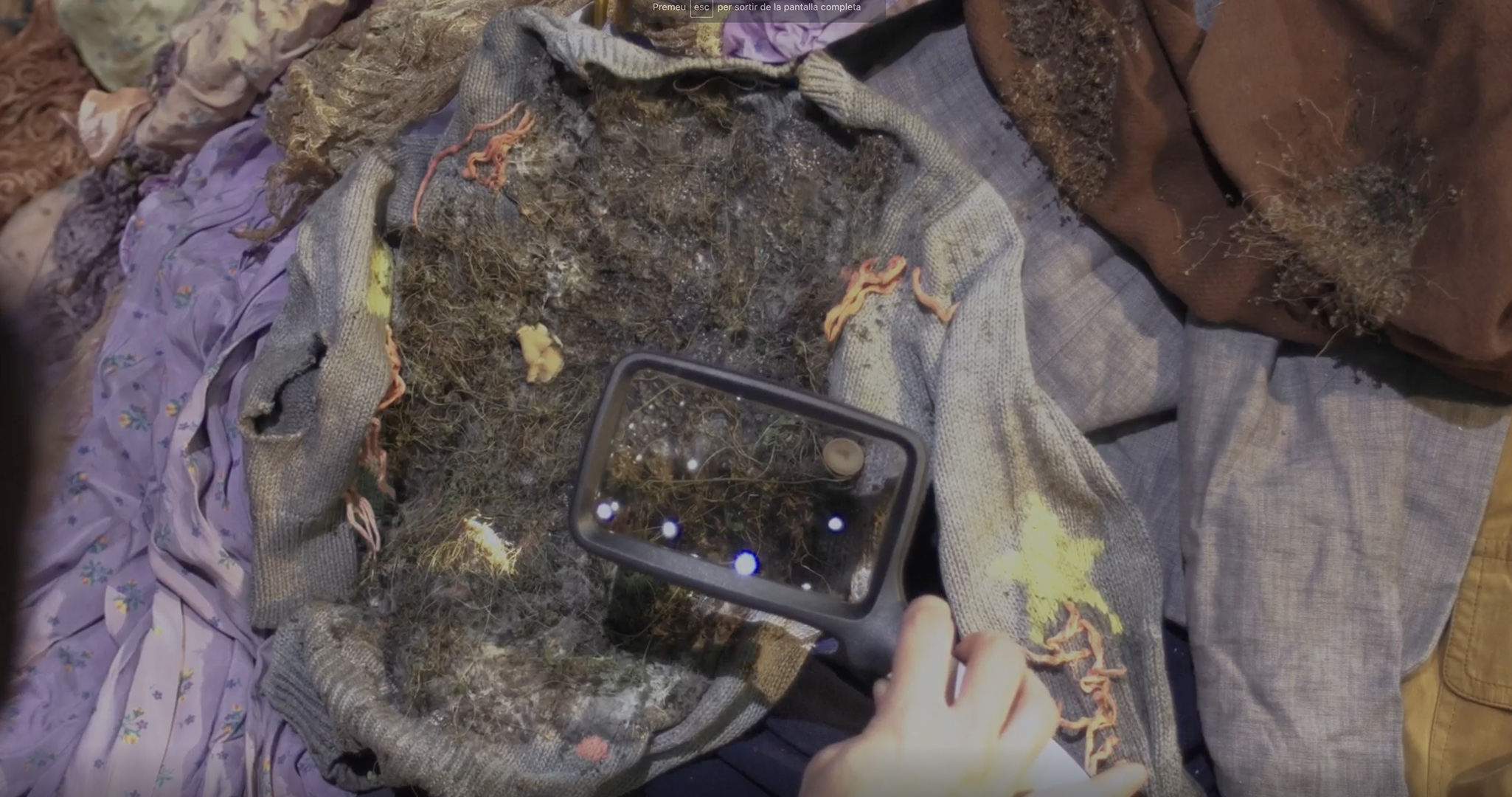
The organisms that make up the CROP fungus colony have traveled from Barcelona to Prague on a two-day car journey. Two people take turns in the driver’s and passenger’s seats, and the rest of the vehicle is inhabited by a rot that must be protected and fed. It must not be exposed to light, and therefore the windows are fitted with screens that neutralize the sun’s rays. The humidity levels must not drop, so they need to be watered periodically; each species at its own pace, in its own turn. The temperature must be moderate, so there is no option to turn on the air conditioning or any kind of cooling system. Forty-eight hours of a journey across Europe and a car full of greenery and whiteness, with not always pleasant smells mixing: one must learn to live with disgust and with life that persists. Once arrived at the Quadrennial, the same system must be maintained: sowing, watering, caring, repetition. Observation. Treating culture and cultivation as something alive. Like a garden.
4
this time ‘we’ would come
to the world like sticks, nailed
to a crop which has gone mouldy —
Oleschinski, Brigitte. Corrent d’esperits (trad. Ramon Farrés, Teresa Pascual i Mireia Vidal-Conte).
Lleida: Pagès, 2008.
5
A landscape can also be the mold that has emerged among the waste, in the discarded. Is the green of moss less beautiful than that of a field wet with dew? What separates disgust from the most pleasing vision? Who decides which forms of life are valid and which inhabit the space of abjection, of malformation, of nausea? With closed eyes, one can savor without qualms a salad covered with moss.
Meeting
Raimon Rius
The Chant
of the Sybil
Raimon Rius
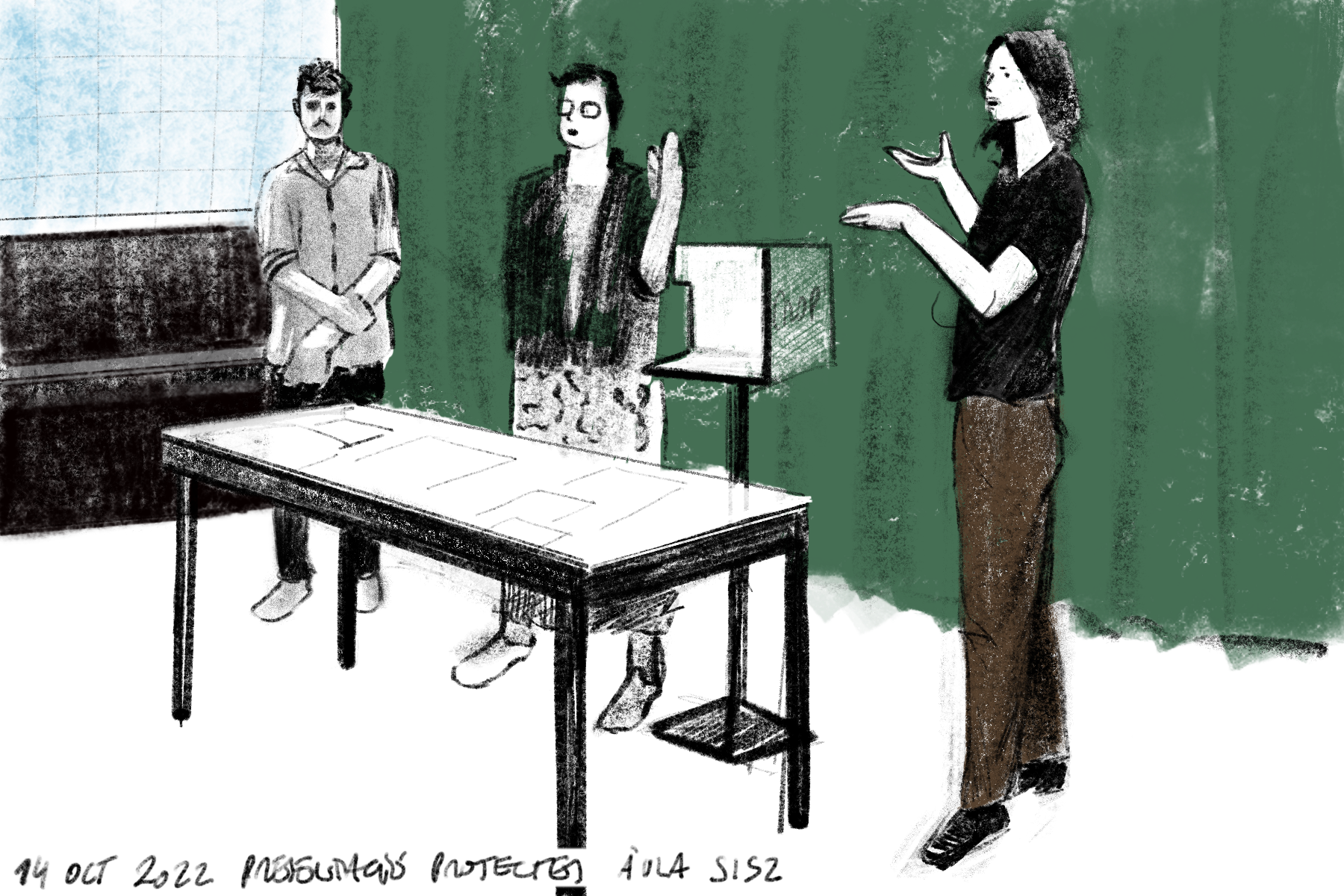
CROP
Raimon Rius
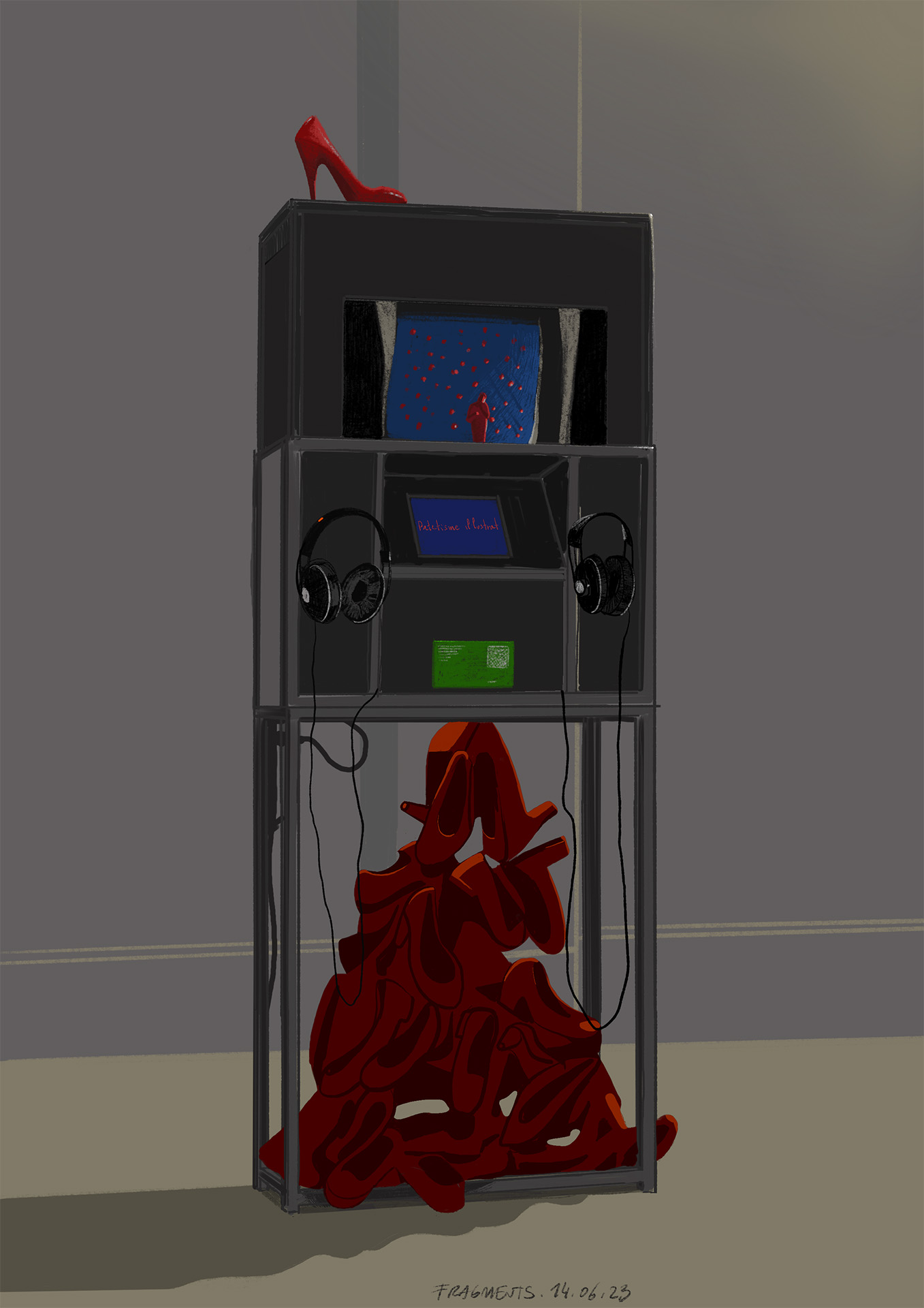
Fragments II
Raimon Rius
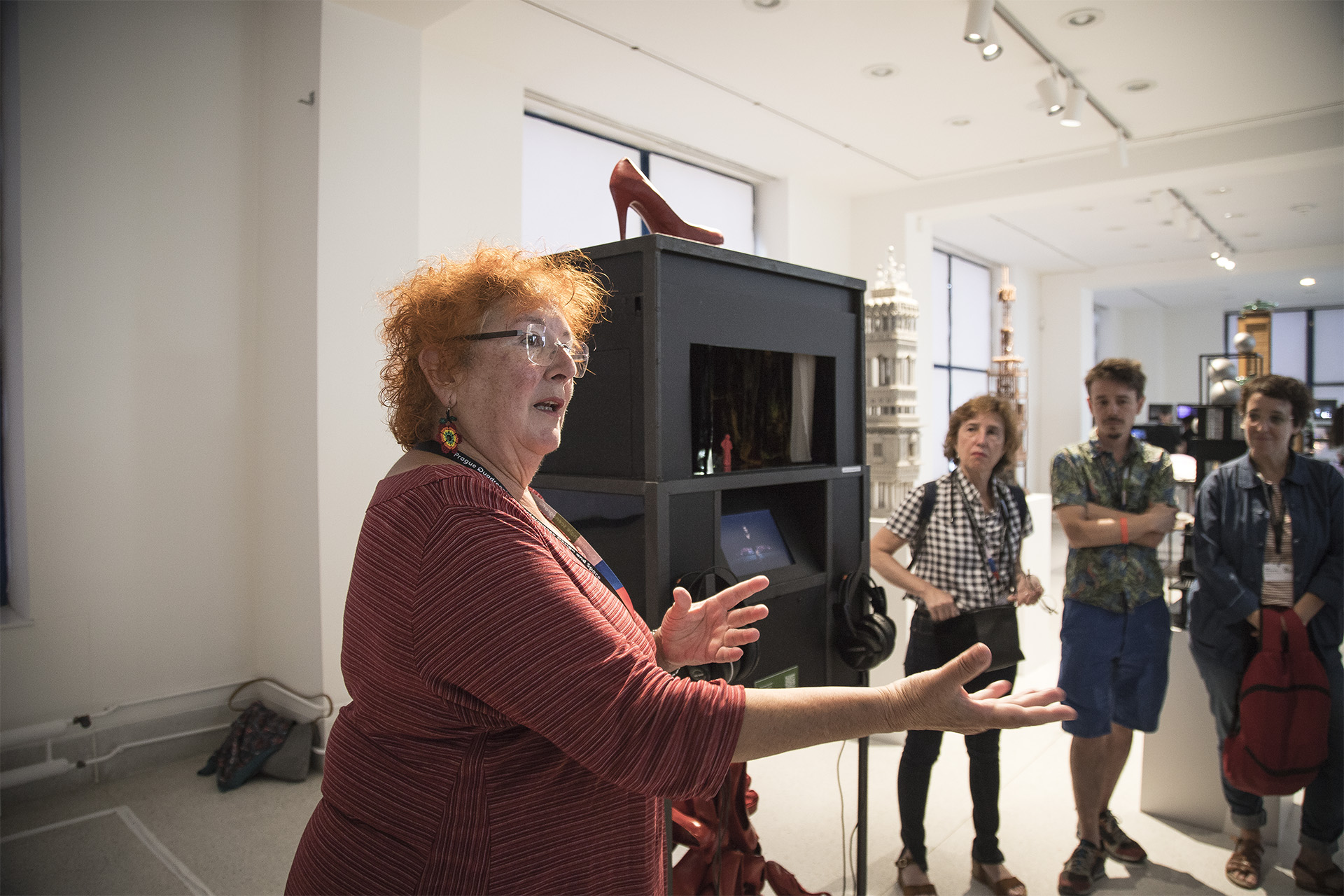
Participation at section Fragments II — Exhibition of scenic models
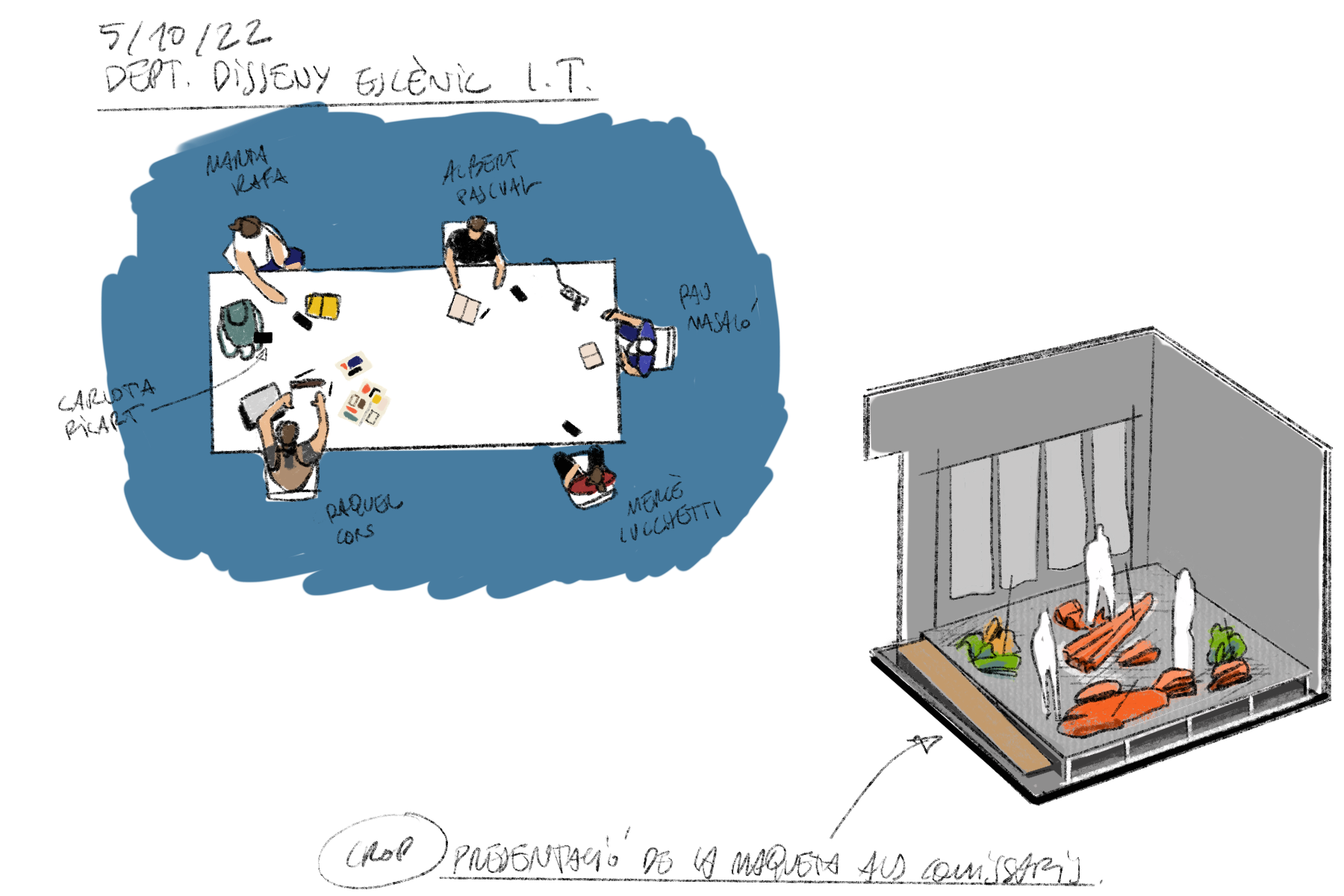
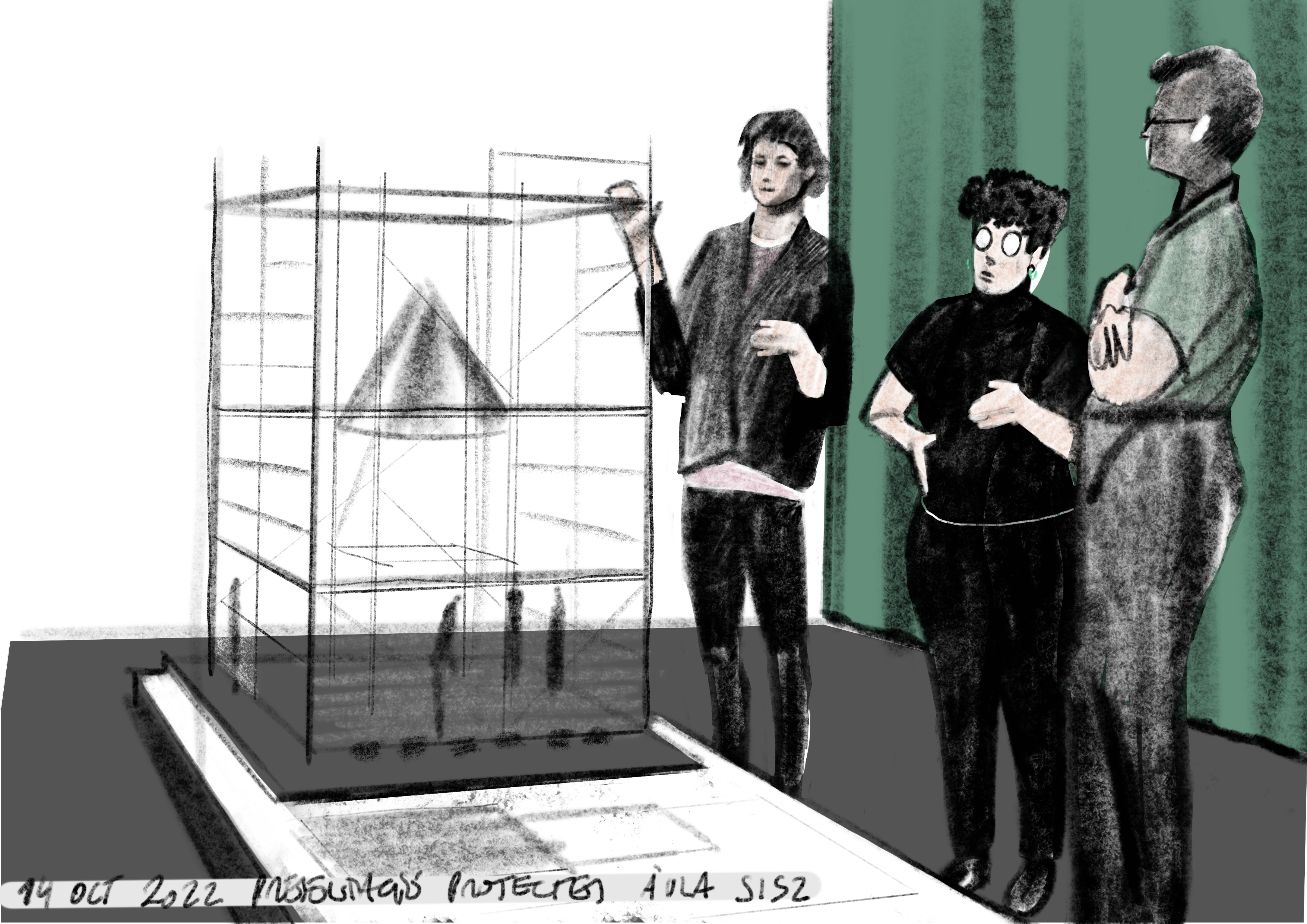
Years after a theatre premiere, the model of a show becomes a witness to an event that has become extinct due to its own ephemeral nature. We often don’t imagine it, but what we see is above all the latency, of what was, and of everything that could have been.
The model was made so that set designer could speak in the first instance with themselves. So that they could imagine the story made of fullness and emptiness, form and content, movement and stillness. So that they could ask themselves about dimensions, scales, points of view, relationships, circulations, entrances and exits, lights and shadows, colours and textures. Later, it became a shared toy, a dialogue, a conversation, a collective projection. It was the reproduction of a small world so that stage directors, lighting technicians, costume designers or performers could imagine how to inhabit it, give it life, make it change, contradict it or pervert it. And, finally, it was also made so that, in the future, others would have the privilege of following the intimate trace of an idea that one day became tangible in the workshop of the set designer.
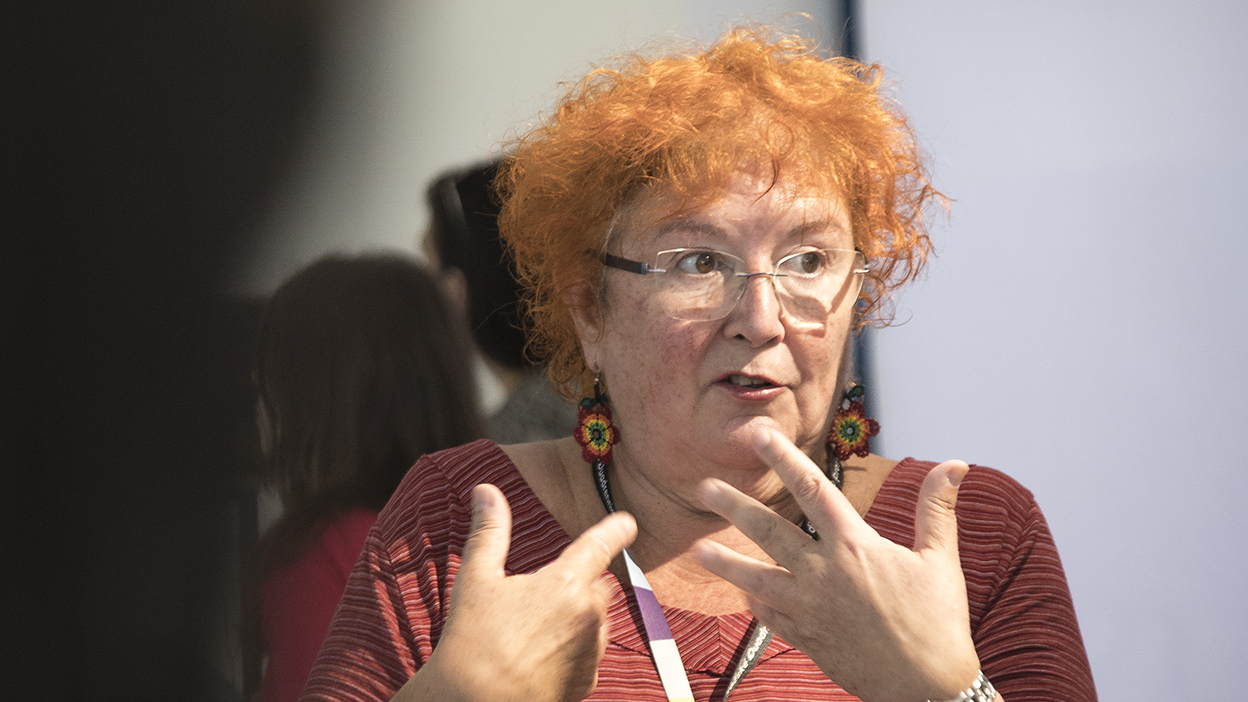
1' 59'' — Montse Amenós about her participation at PQ.
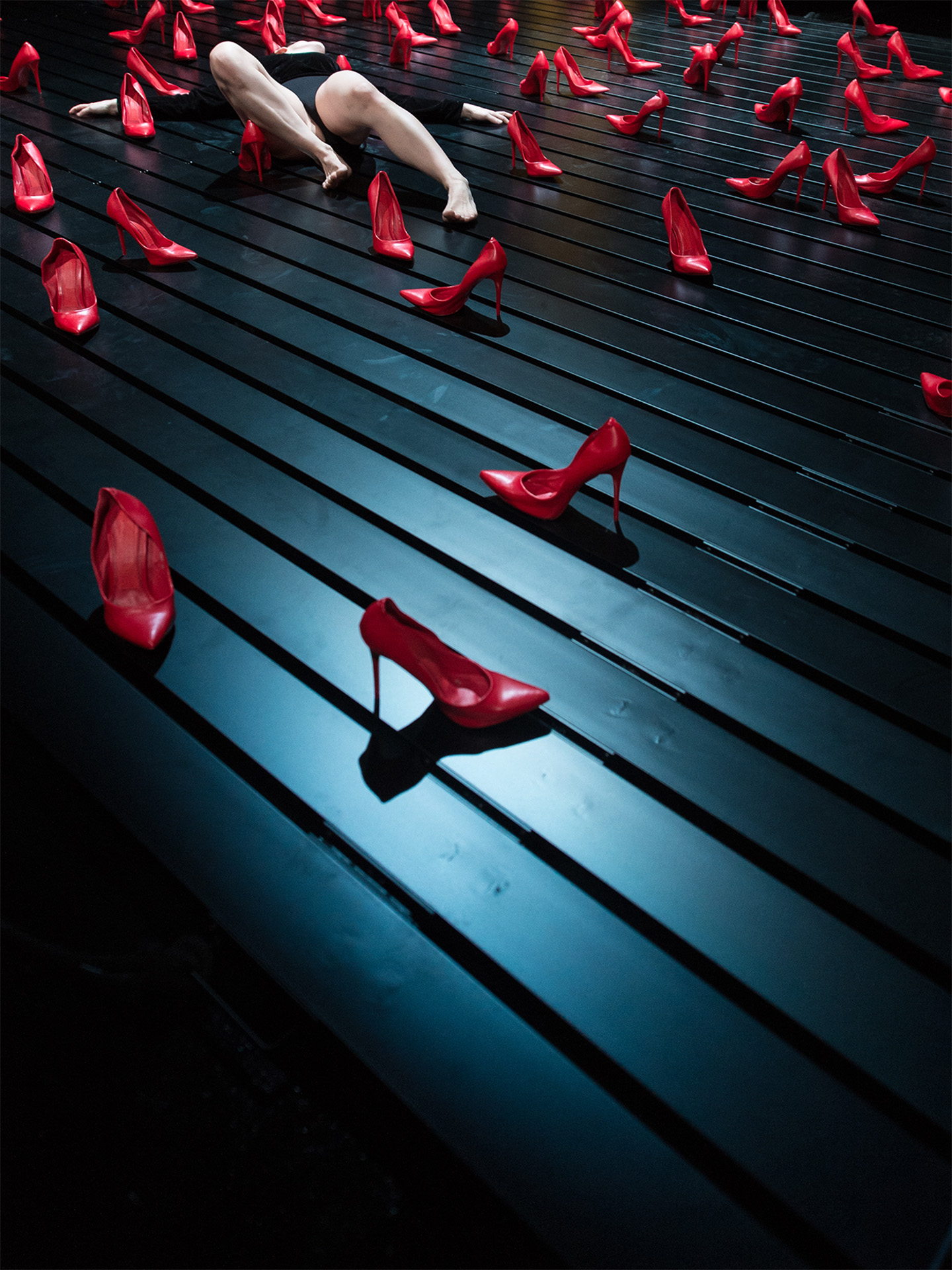
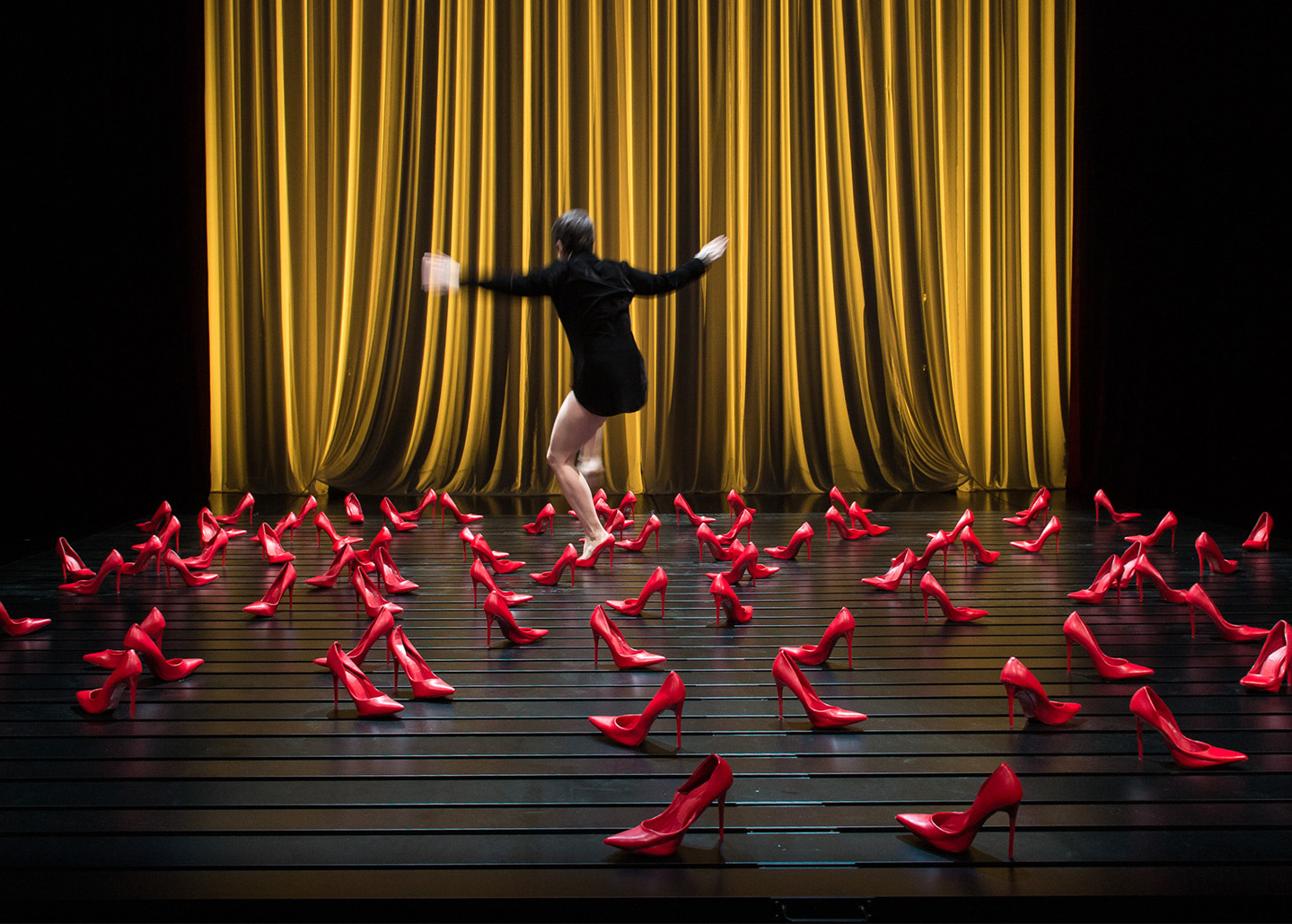
Photography by Joan Martínez
Photographies by May Zircus
In On the Concept of History (1940), the German philosopher Walter Benjamin wrote: “There is no document of civilization which is not at the same time a document of barbarism”, and it seems that CROP and The Chant of the Sibyl rest on this idea that lies at the heart of a still burning issue. Both installations approach culture as an intangible fact which, when becoming communal – performance, fiction, vision, ritual –, has been embodied and palpable. We see cultivation as what is grown1 over time – millennia or decades – as a representation of a community of either beneficial or perverse,2 aspiration, although almost never innocent. Culture appears as a remain or trace of what has existed; a document whose plot is made of citations, with the nuance that it renders it shifting and alive.3 The living organisms are born, grow, reproduce and die. They turn mouldy,4 later. Like a landscape.5 Like a hypertext.
Sebastià Portell
1
CROPS, GROWING, CULTURE
Cultivation: the act of preparing land and growing crops on it, or the act of growing a particular crop. Cambridge English Dictionari
We are cultivated people. We have millions of bacteria. Estíbaliz Espinosa
There is a hand, and in the hand, seeds
And there is the land ready to be cultivated:
The location is right, it has sufficient hours of sunshine −
And it has already been fertilised
− You can smell the dung on the other side
Where you and I are now, both far enough away not to get dirty
And close enough to follow it
And be able to say the key is in the hoe, the movement,
It is important to wait, you need to follow the process,
Statements that do sound good.
There is a hand, I said, and in the hand, seeds
Which will have to be planted carefully
Within the space delimited by the plots:
The beans with the beans separately
And the tomatoes here, as has been always done.
It is logical, you say. It is poor, I reply.
It is poor and I would even say scary
To follow an order imposed, so much purity
And so little to question these straight lines,
Patterns of regular, symmetrical rows
Like graves buried without a slab
From which nothing can any longer grow or die
And of course the fact that nothing can grow is a problem,
But that it cannot die is a catastrophe.
There is a hand, still this hand
That holds the seeds for the crop
And knows the exact size of the land
As your father, and your father’s father, knew.
It is tradition and excellence, you argue,
And I see you admiring the body that precedes the hand
And it surprises and hurts and deceives, you don’t know how much,
That you don’t see the absence, that you don’t care
And don’t wonder where your mother has been til now
And where your daughter will be other than at home.
The tradition you advocate has the colour
Of the knife with which she, nameless like all,
Is just about to cut the neck
Of an animal that will end up on the table,
Chopped up, with vegetables, the vegetables
That the field has given us, thanks be to God
Bless this table and we swear
To say nothing of the violences
And so we’ll be accomplices just as much as You, Amen.
There is the hand, I repeat, and the question:
Why is a single hand responsible for sowing
If the makers of the kitchen garden are so diverse?
On this piece of land, for example,
You should keep in mind the worms, nearly one thousand worms
That every day and in the dark, what an offering,
Manage to speed up the composting
Process, and do so without a word,
Without expecting front pages or applause
Although they know the end of this story,
They know that everything will be for the owner of the hand,
The hand that has appeared in the first verse,
The hand that will approve the brand, the recognition
“Thank you all for being here today, it is an honour,
I’m happy the critics appreciate
The effort I’ve made so far. My radishes,
My carrots, my peppers are for you.”
Until when this worship of the I,
Until when the indifference for what adds,
For everything that is there and can be seen only if you so desire?
There is the hand, the hand that holds the seeds
And at this point we believe we know them.
Precisely of high points comes to speak
The bird flying over the landscape now
(We’ll notice it because for some time
Its shadow has been cast on the wrist
Of this hand which, certainly, overwhelms us).
You need to look up, to fly very high and project yourself
You have proclaimed with the tone of a visionary,
Of someone who sees the fruits that will go
To a supermarket let’s say in Greenland.
For you reaching far means working
So that the seeds grow products
That can be understood everywhere, that are not too acidic.
This for me instead means exports,
Ten thousand planes crossing the sky, pallets and boxes,
Three tons a month of tasteless fruit,
Which being so digestive can cause anxiety.
But go ahead, look very high and slowly forget
What you have nearby, what takes roots in the soil,
How much water it needs, if it has been thirsty for long.
Then, however, don’t do like so many others,
Don’t blame the land for not being fertile
Don’t say how can it be, what a tragedy.
I know: being consistent is very hard
You feel very settled in the distance
That words impose with facts
(So says someone who speaks to you in a poem
And who turns the metaphor into a curse,
And wants the curse to have effects,
To call attention, like the dawn on the sunflowers.
So says someone who is haltingly writing the last verses
Just when the hand that guides the text disappears
And does not bid farewell to it because it suddenly begins to rain,
It’s raining a lot, it rains so much that he will have to go home
And you’ll remain between the crop and the metaphor,
There where you won’t be able to see how many puddles
There are right now on the asphalt).
Calafell, Mireia. Nosaltres qui.
Barcelona: LaBreu Edicions, 2020.
2' 14'' — CROP, Meritxell Colell
2
My time is not yours. Neither is it mine. Time
Depends on the speed of the clock that measures it,
And the speed in me is not the speed in you,
For such a sharp reason as it is
That the journey you make is not the journey I carry with me.
I want to say that you shouldn’t apply a dissembling copyright on time,
While scholarly speaking of “our time”,
Because those who love just their time
And certain traditional images of man
Have more or less communed with Germany.
My task is to See what there is, not what’s going on…
What’s going on sees me.
I want to see just the man, to see if he is alive,
Above all the human splendour in which the crisis is the personality.
Instead, however, seeing the man who lives in crisis,
I am fed up of seeing little men who live from the crisis,
And this is because
Those who love only their time
And certain traditional images of man
Have more or less communed with Germany.
If you want to be a man,
Try, first at all, to be vigilant.
Try not to have a master
Who trains you in the image of his clinical picture.
He will just show you that you maintain it
And you commune with his cave painting,
If what you want is to be given the card of subject.
That way you will catch the filthy disease of decency
And the coarse dirt of silence. You will be an aesthete
And this is the jug of beer
That helps you swallow the mouldy bread,
But those who love just their time
And certain traditional images of man
Have more or less communed with Germany.
If you want to be a man,
You don’t have permission to think that you were born as such.
You were not born a man, but you have to return.
Your only task is to ensure
That clear things become public.
Woe to you, however, if you allow the others to make you man
You will catch the dirty disease of decency
And the rude roar of silence. You will be an aesthete,
And that's because
All those who love only their time
And certain traditional images of man
Have more or less communed with Germany,
And this is the jug of beer
That helps to swallow the mouldy bread.
If you want to be a man, don’t say that the foot of a man
Is more modern that the hoof of a horse.
Never say just “I” when you do a thing correctly.
Never dare say just “I” when you do a thing wrongly
Never try to say “flower” to a faded flower.
Never dare say “fight” to a carnage.
Do not approach the pig that says “undocumented”
To someone who does not carry their parents, street and gender written on a piece of cardboard.
You are shameless, if you think
That everything that a card says about a person is true.
If you comply with all this, you will be an aesthete,
And this is a jug of beer
That helps to swallow the mouldy bread.
I believe in justice and in the righteous
But, as the authority is mutual or is not,
In exchange for my faith in justice,
Don’t let any judge from here in Catalan or from the country dare
put his signature, or flourish, under pain of 12 bullets,
If he is not himself, from his own hand,
Who put the convict to the garrotte, the gallows or the bullet.
Because the gallows, the bullet and the signature must bear the same hand.
Otherwise, you are
Like those who love just their time
And certain traditional images of the man,
Because they have more or less communed with Germany,
And this is a jug of beer
That helps to swallow the mouldy bread.
Bonet, Blai. Has vist, algun cop, Jordi Bonet, Ca n’Amat a l’ombra?.
Barcelona: Borràs Edicions, 1976.
3
The organisms that make up the CROP fungus colony have traveled from Barcelona to Prague on a two-day car journey. Two people take turns in the driver’s and passenger’s seats, and the rest of the vehicle is inhabited by a rot that must be protected and fed. It must not be exposed to light, and therefore the windows are fitted with screens that neutralize the sun’s rays. The humidity levels must not drop, so they need to be watered periodically; each species at its own pace, in its own turn. The temperature must be moderate, so there is no option to turn on the air conditioning or any kind of cooling system. Forty-eight hours of a journey across Europe and a car full of greenery and whiteness, with not always pleasant smells mixing: one must learn to live with disgust and with life that persists. Once arrived at the Quadrennial, the same system must be maintained: sowing, watering, caring, repetition. Observation. Treating culture and cultivation as something alive. Like a garden.
4
this time ‘we’ would come
to the world like sticks, nailed
to a crop which has gone mouldy —
Oleschinski, Brigitte. Corrent d’esperits (trad. Ramon Farrés, Teresa Pascual i Mireia Vidal-Conte).
Lleida: Pagès, 2008.
5
A landscape can also be the mold that has emerged among the waste, in the discarded. Is the green of moss less beautiful than that of a field wet with dew? What separates disgust from the most pleasing vision? Who decides which forms of life are valid and which inhabit the space of abjection, of malformation, of nausea? With closed eyes, one can savor without qualms a salad covered with moss.
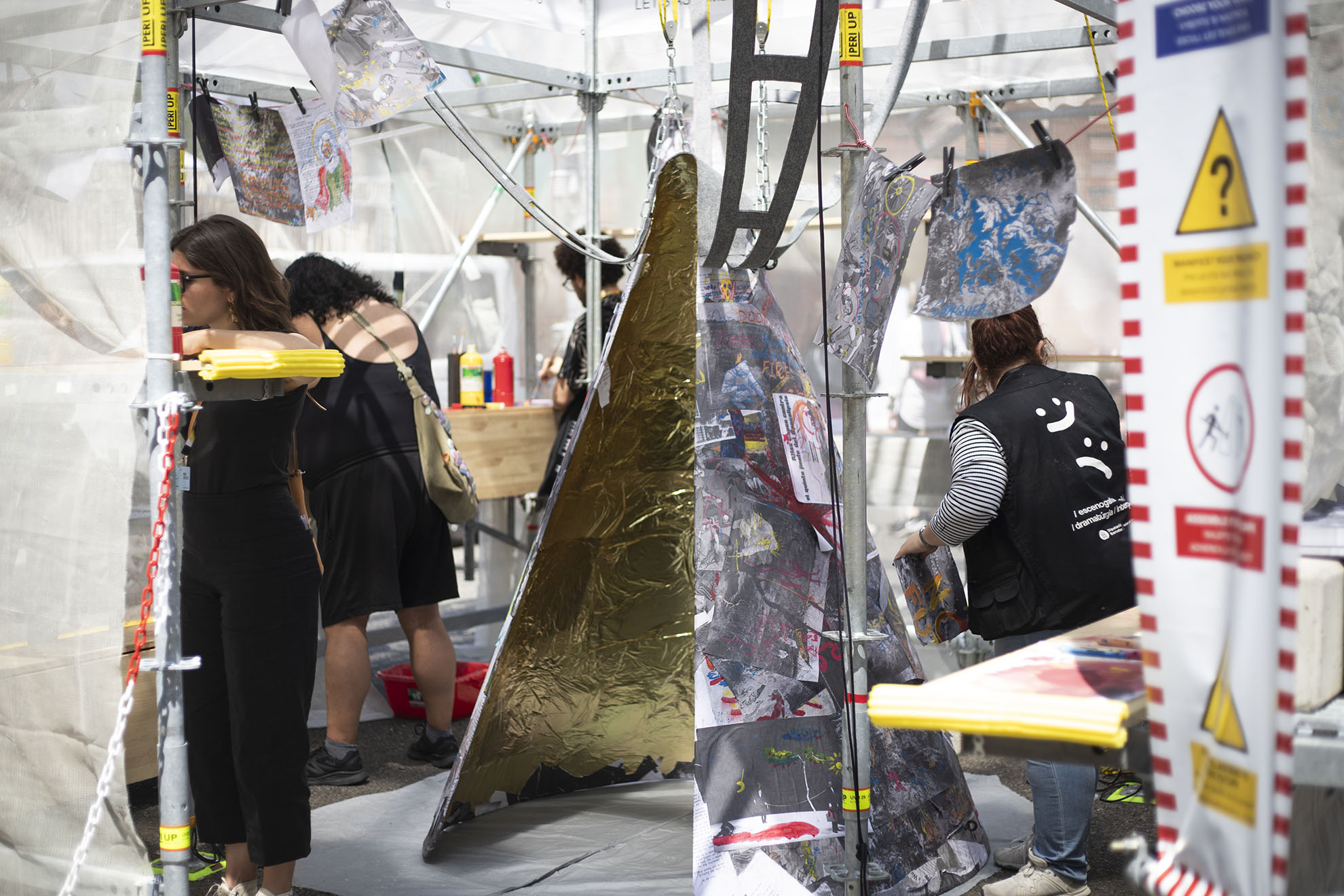
Drawings by Raimon Rius
Drawing by Raimon Rius
Participation at section Fragments II — Exhibition of scenic models
Years after a theatre premiere, the model of a show becomes a witness to an event that has become extinct due to its own ephemeral nature. We often don’t imagine it, but what we see is above all the latency, of what was, and of everything that could have been.
The model was made so that set designer could speak in the first instance with themselves. So that they could imagine the story made of fullness and emptiness, form and content, movement and stillness. So that they could ask themselves about dimensions, scales, points of view, relationships, circulations, entrances and exits, lights and shadows, colours and textures. Later, it became a shared toy, a dialogue, a conversation, a collective projection. It was the reproduction of a small world so that stage directors, lighting technicians, costume designers or performers could imagine how to inhabit it, give it life, make it change, contradict it or pervert it. And, finally, it was also made so that, in the future, others would have the privilege of following the intimate trace of an idea that one day became tangible in the workshop of the set designer.
1' 59'' — Montse Amenós about her participation at PQ.
Photography by Joan Martínez
Photographies by May Zircus
Catalonia at PQ23, David Corral